STORMHAVEN
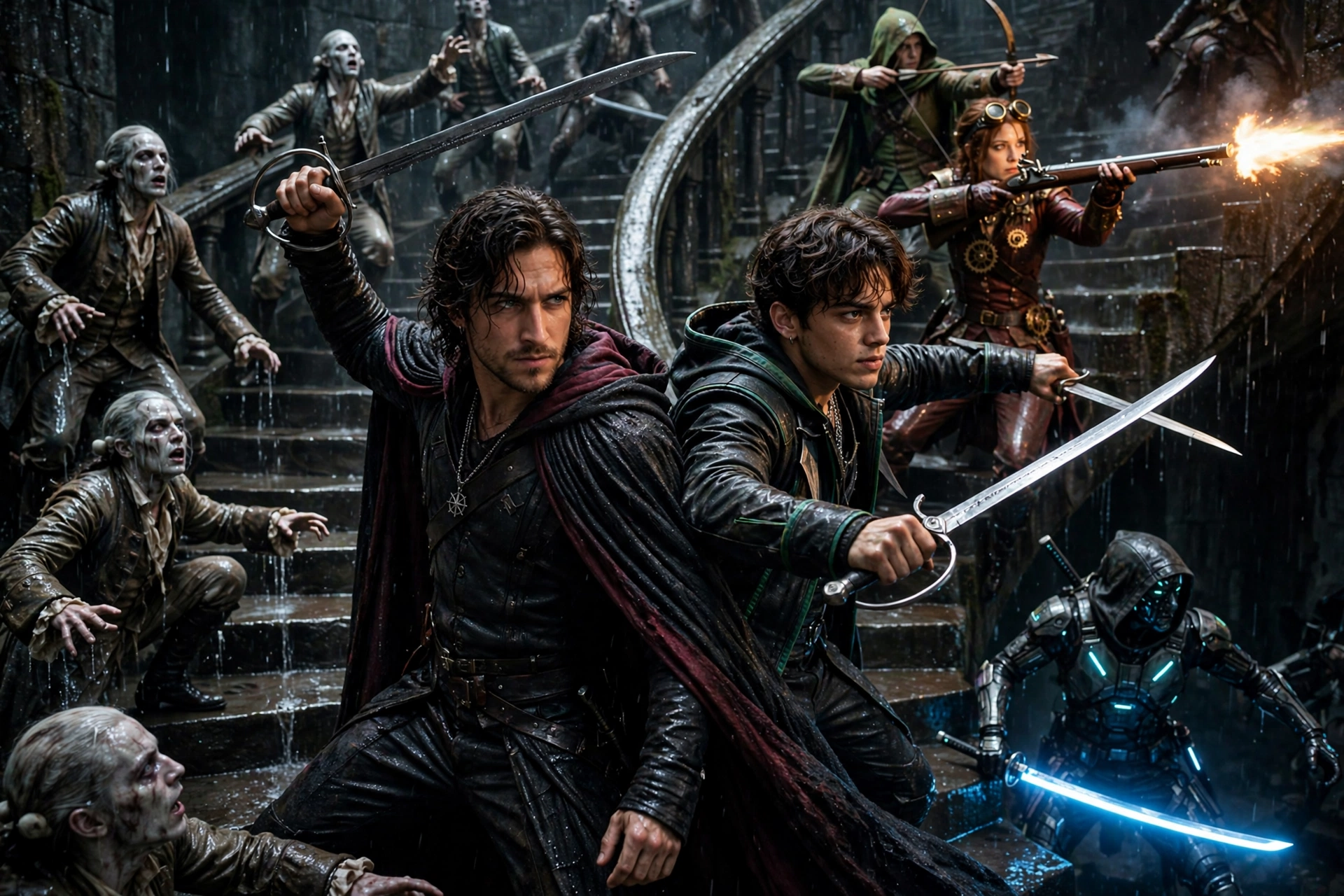
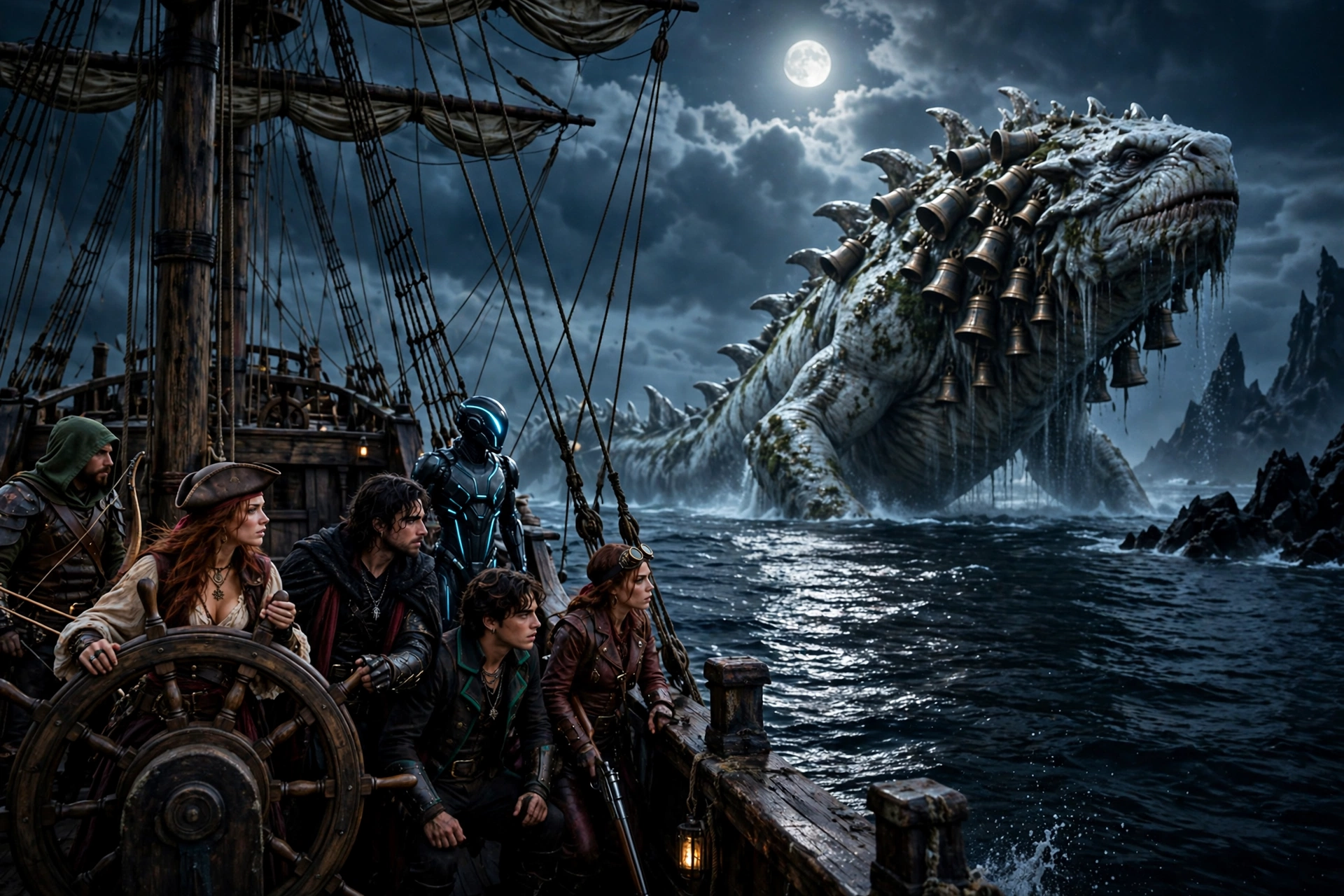
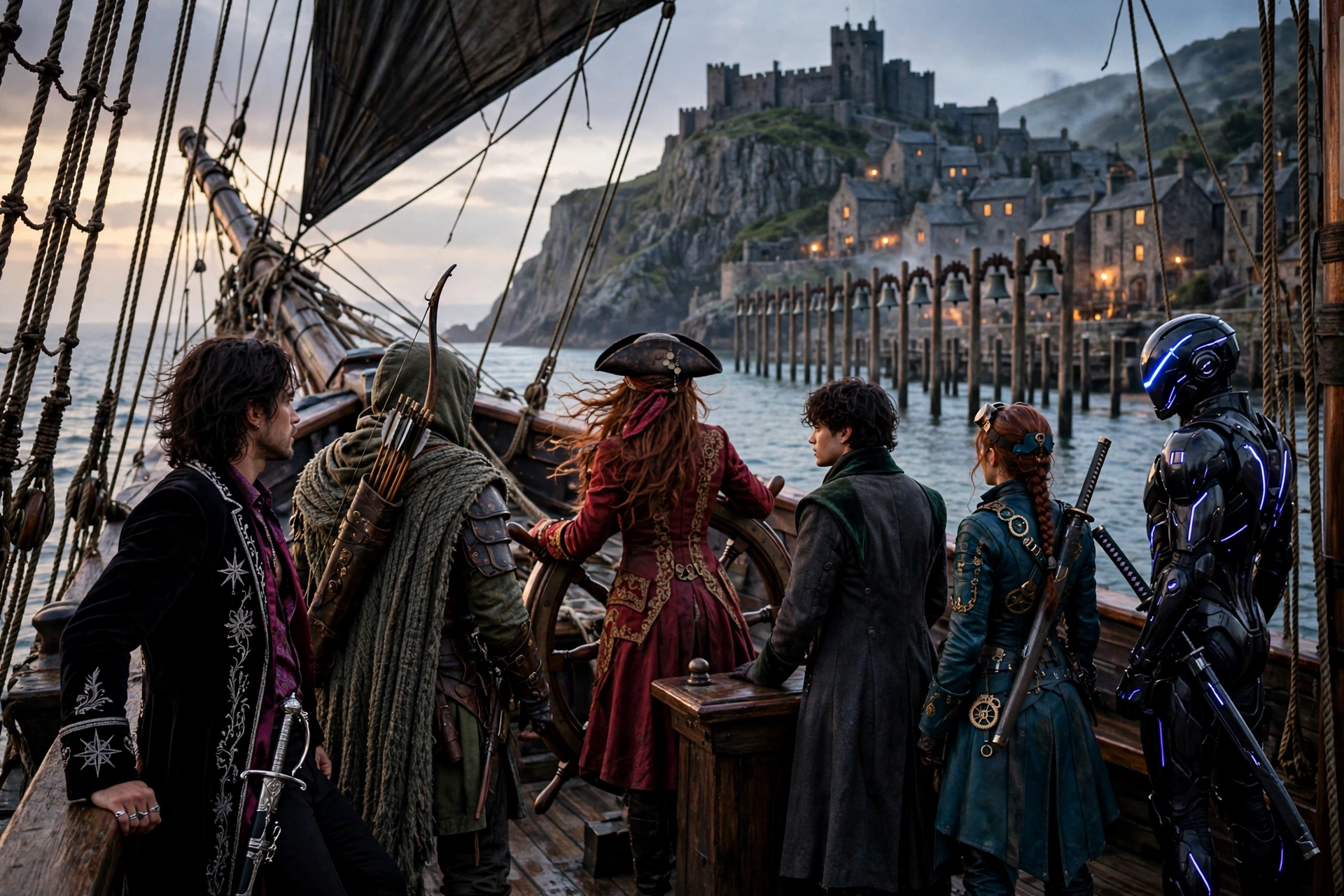
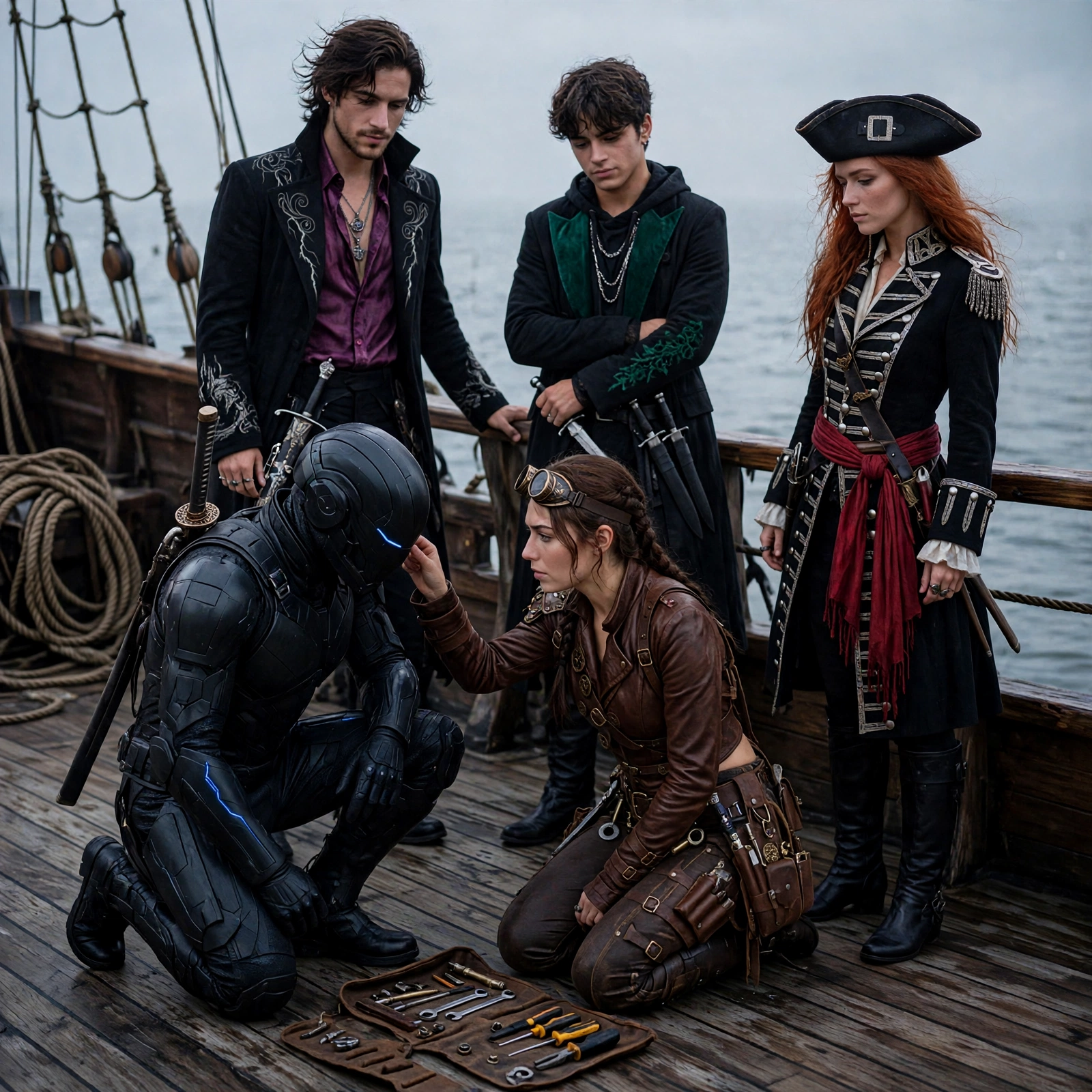
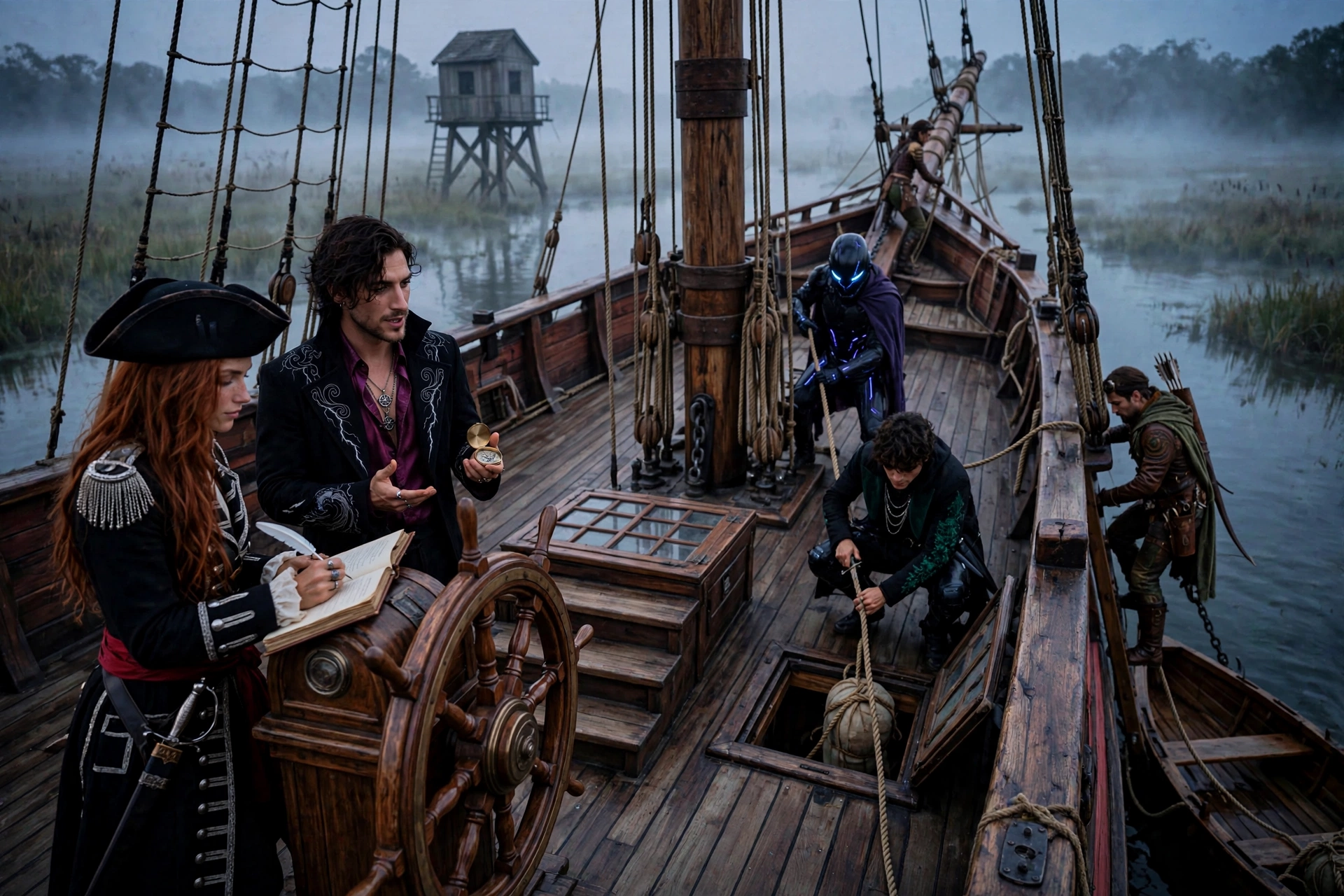
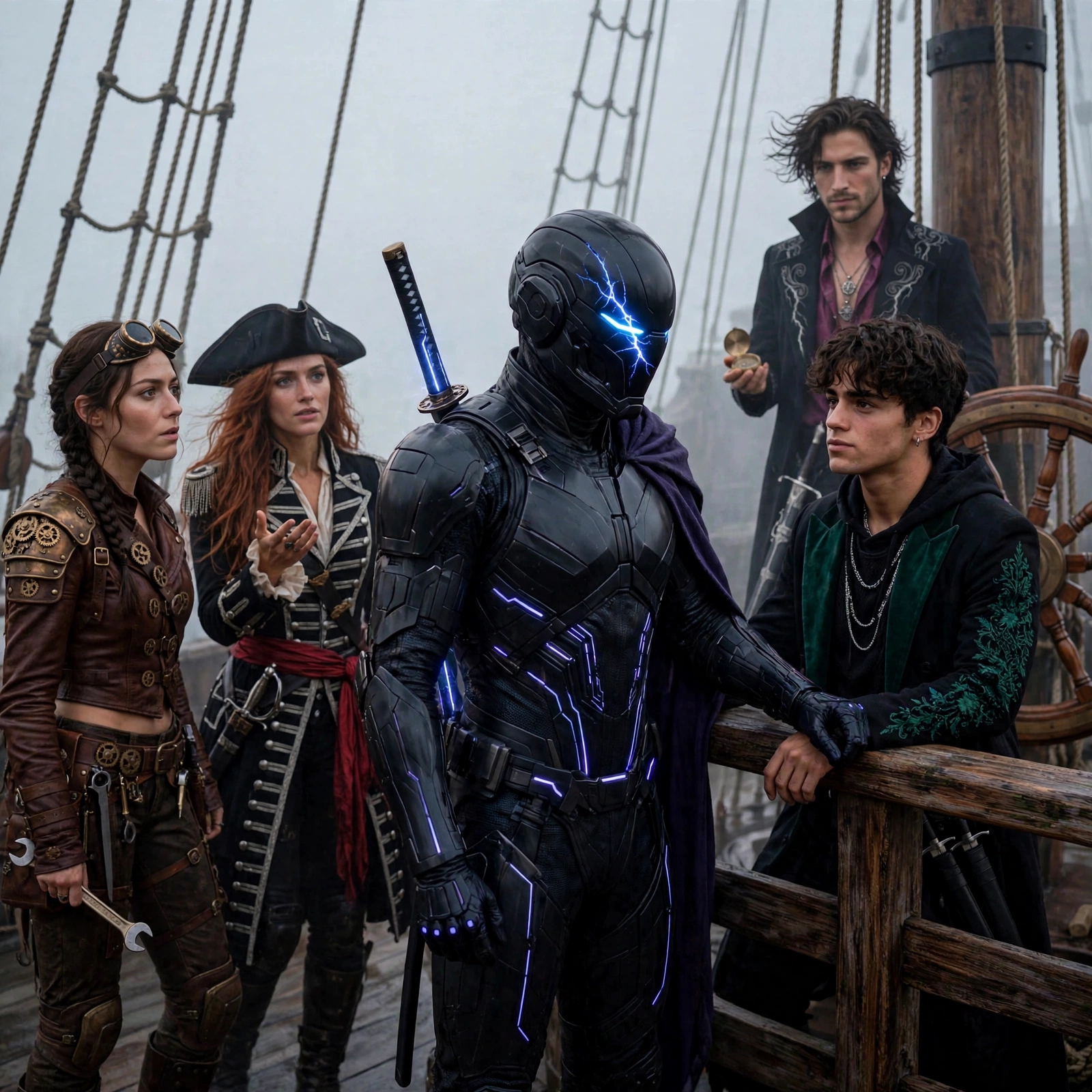
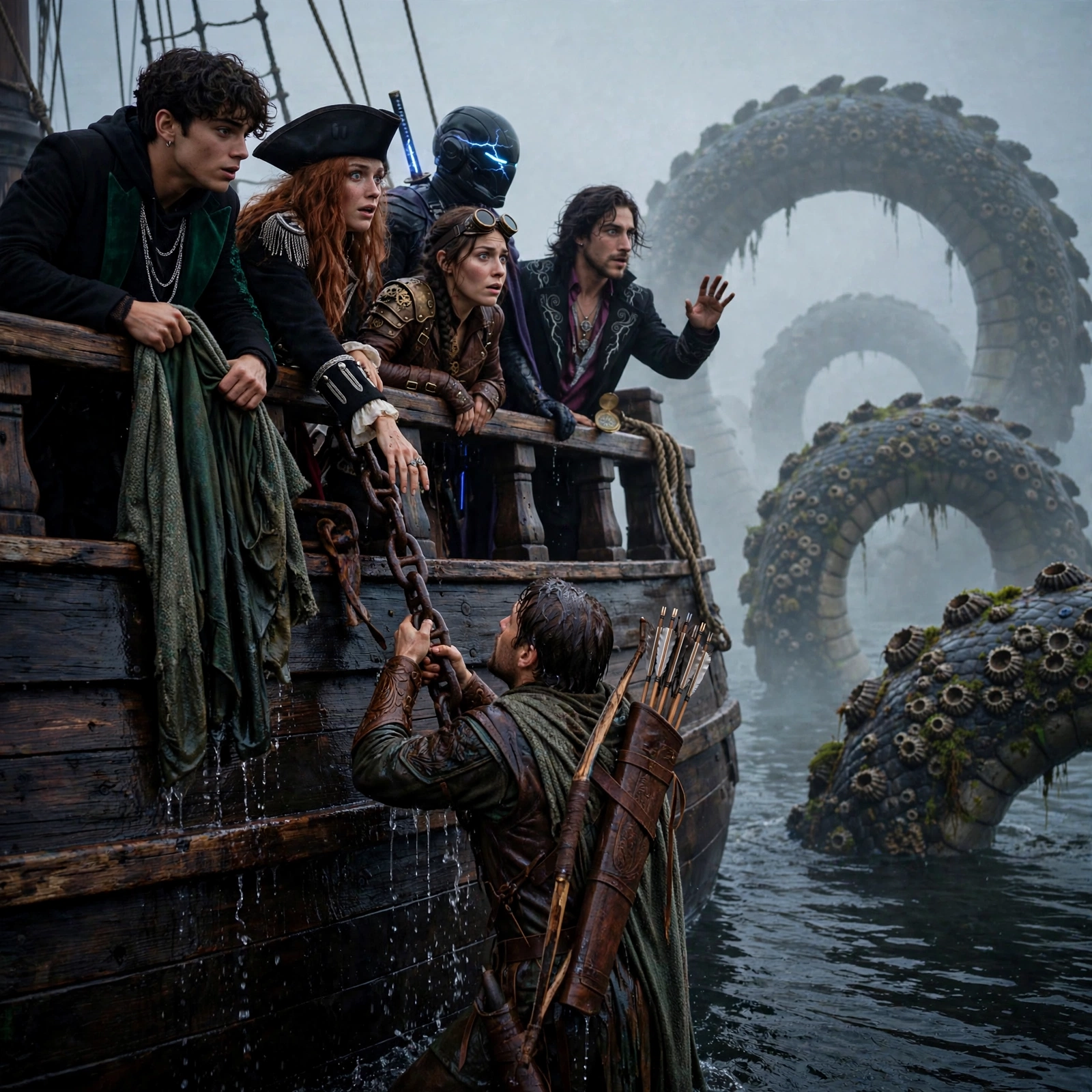
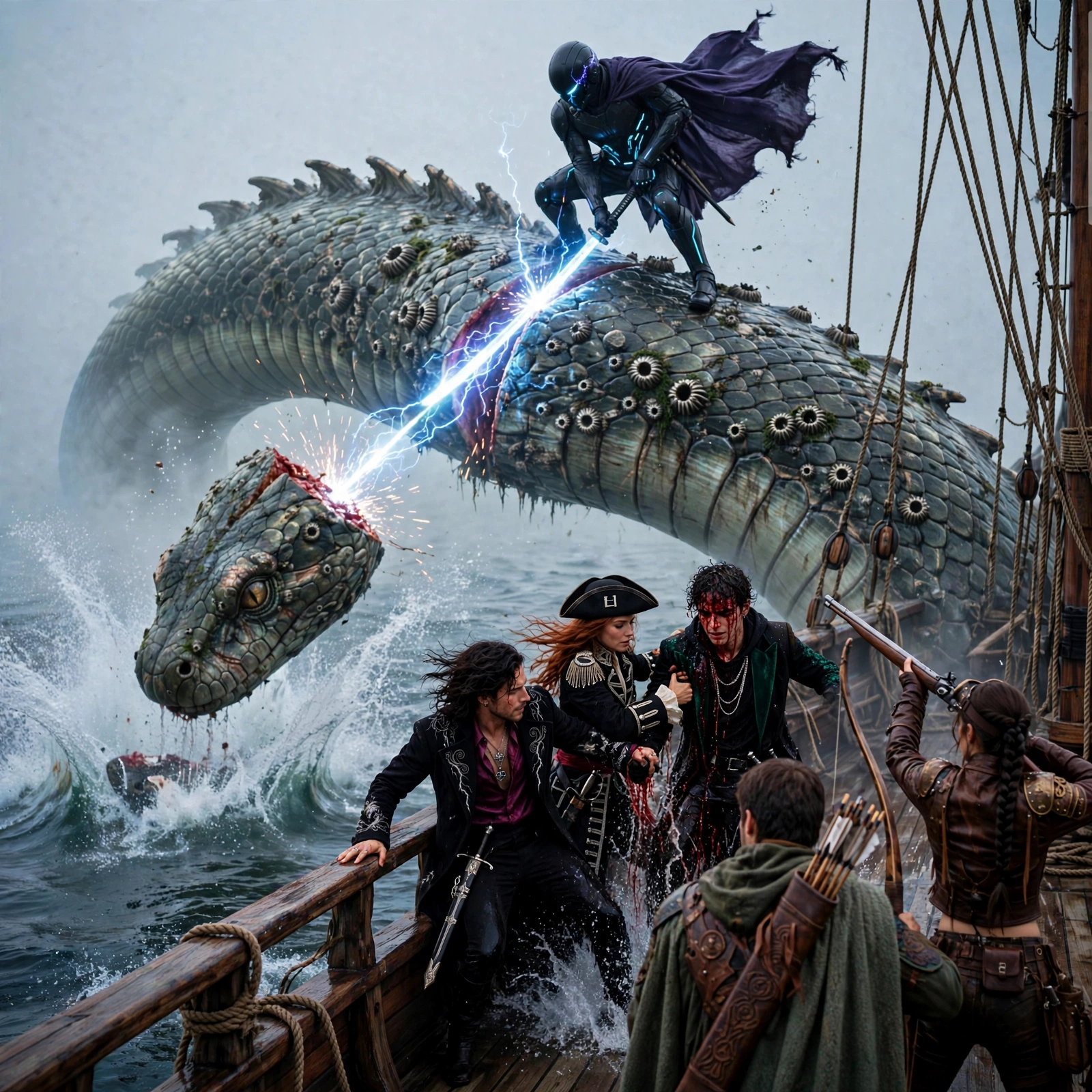
The Stormhaven crew on deck in the storm — the Captain with his chart, Kaleb, Vesper, Rowan, Heather, and Volt in his closed helmet with the blue visor lit

The Complete Saga · Parts One–Five

STORMHAVEN

Six sailors, ninety-seven stolen bells, and the sea that rings for the dead — the saga of the Captain and his crew, from the tower that was a lock to the forge at the edge of the marsh.

The Captain · Kaleb · Vesper · Rowan · Volt · Heather

Begin Reading

Told by the Captain, from the first night the sea said no.

Contents

Five parts · fifty-three chapters · one unfinished sea

Part OneThe Lamp Is a Lock
Chapter One — The Night the Sea Said No Chapter Two — Stormhaven Chapter Three — The Tower Door Chapter Four — The Fight Chapter Five — Finding Heather Chapter Six — Light It, Fast Chapter Seven — The Fight to Get Her Out Chapter Eight — Getting Out Chapter Nine — Out of the Tower Chapter Ten — The Lamp Catches Chapter Eleven — To the Ship Chapter Twelve — The Wheel Is Yours
Part TwoDead Man’s Reef
Chapter One — The Confession Chapter Two — The Map Chapter Three — The Full-Moon Tide Chapter Four — Through the Teeth Chapter Five — The Grandsire Chapter Six — The Fight Chapter Seven — The Trouble Chapter Eight — The Hoard Chapter Nine — The Signal Chapter Ten — Jonah Chapter Eleven — The Flight Chapter Twelve — The Repairs Chapter Thirteen — Two Captains
Part ThreeTollhaven
Chapter One — Loading the Treasure Chapter Two — Through the Teeth Chapter Three — The Sail Chapter Four — The Arrival Chapter Five — Into the City Chapter Six — Supper with the Chief Chapter Seven — The Plan Chapter Eight — The Two Watchers Chapter Nine — The Reading Chapter Ten — The Arrest Chapter Eleven — The Cells Chapter Twelve — The Lock Chapter Thirteen — Out in His Own Colours Chapter Fourteen — The Cut Rope Chapter Fifteen — Dawn
Part FourGullmarsh
Interlude — THE ARMOUR, PART TWO Chapter One — THE FROGS Chapter Two — THE SCOUT Chapter Three — THE TALK Chapter Four — THE CHAIN Chapter Five — THE HEAD Chapter Six — THE STRIKE Chapter Seven — BETWEEN Chapter Eight — IN HALF Chapter Nine — HOLD STILL Chapter Ten — TO THE SHIP Chapter Eleven — WORTH IT
Part FiveThe Forge
Chapter One — THE FORGE

Stormhaven

Part One

The Lamp Is a Lock

Chapter One — The Night the Sea Said No

Chapter One — The Night the Sea Said No — illustration

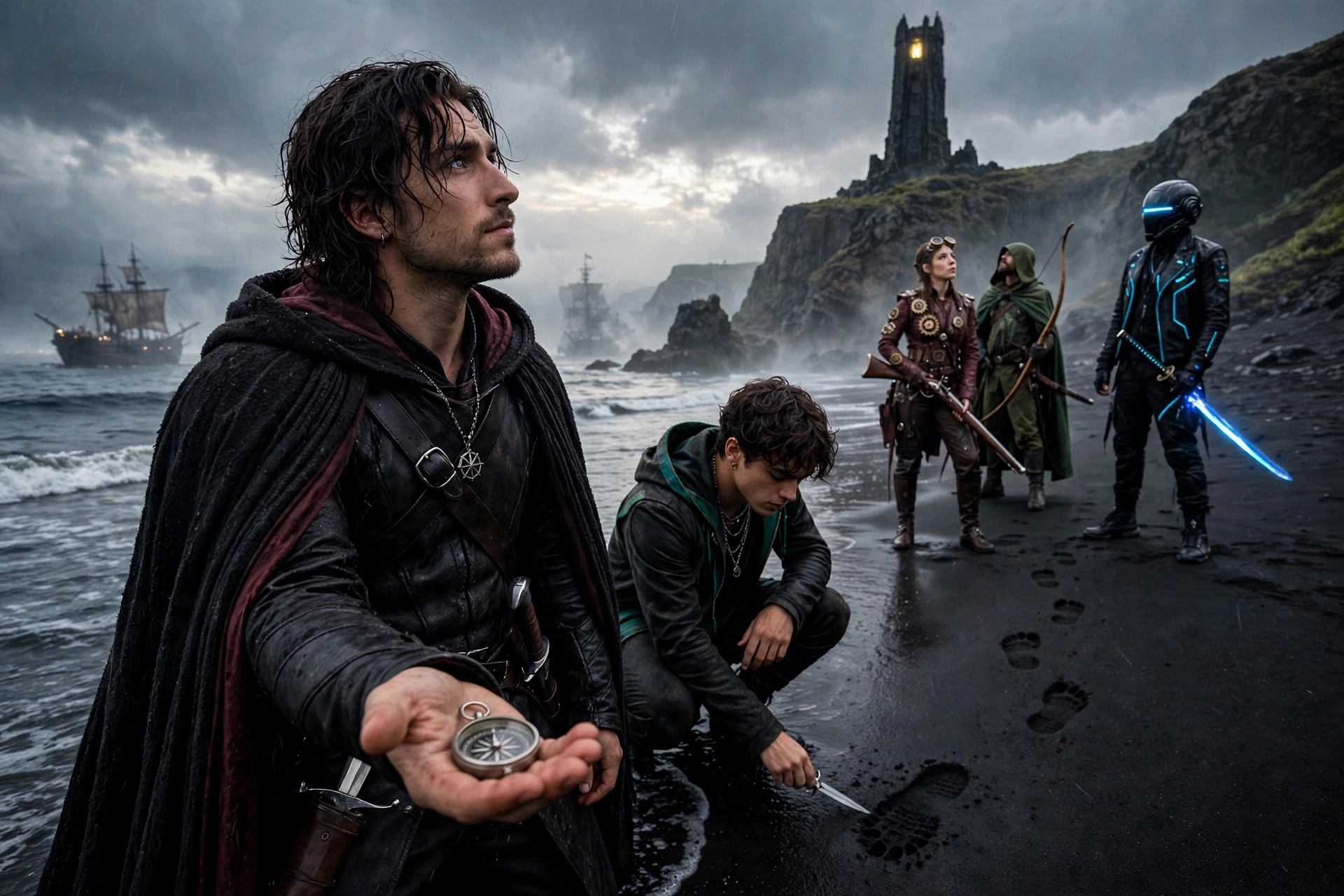
Before I tell you about the island, you should know who sailed with me. A crew is not a list. It's the sound a deck makes under five different pairs of boots, and I knew every one of them by ear before I ever saw a face in the dark.

There's me. The Captain. I read the chart — the inked reefs, the margins where other men's warnings ran out. I don't read fear. Fear is weather. You note it, you dress for it, you sail anyway. The compass at my chest had hung quiet for a year, ever since the night my first ship went down and I woke on her wreck with it closed in my fist. That night it had begun, very faintly, to warm.

Kaleb came up the companionway without a sound, the way he always did, hood up, emerald dark at his throat. Shadow-rogue. Two daggers, two speeds, one heart — that was Kaleb entire. He could be laughing at your elbow before you'd heard him cross the deck, and he could be gone again before the laugh finished. Whatever the night was going to ask of us, it would ask him first to be quick, and he would answer before it finished asking.

Vesper stood by the mast with her rifle across her back, checking the seal on the lock for the third time, though it had been perfect the first two. Steampunk gunner, grease under her nails, goggles up on her brow. She built that rifle herself, every screw and spring of it, and she trusted it the way she trusted nothing else she hadn't made. "Count your shots," she said to no one, the way other people say their prayers.

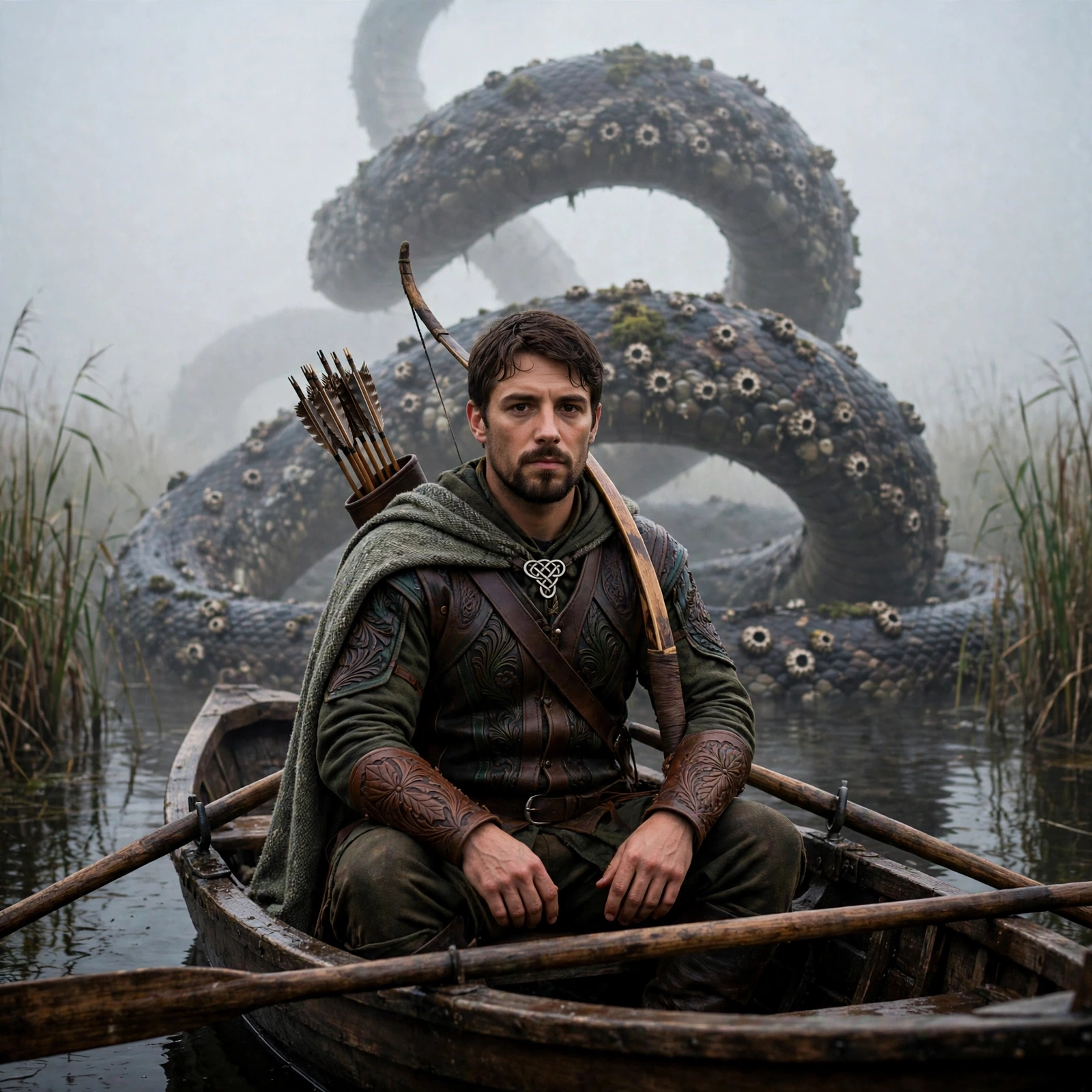
Rowan sat in the bow with his bow across his knees, watching the water change. Archer. The storm doesn't move his arrows — that was the plain truth of him, stated the way he'd state it himself, flat as a plank. He had been a watcher once, on another coast, for another master. He didn't talk about it. He watched the sea the way a man watches a door he once opened for the wrong person.

And Volt stood at the rail, apart, the way he always stood. Cyberpunk blade, matte black from helm to heel, the blue of his visor steady in the gloom. His katana hums when trouble is close — a note you felt in your teeth more than heard. All evening I could feel it: low, and rising.

"You hear that?" Kaleb said, low, nodding at Volt's blade.

"I feel it," Vesper said. "In my teeth. Same as you. Don't pretend you're special."

"I am special. That's the burden."

"Hush," Rowan said, without turning from the water. "Both of you. Listen past it."

We did. Under the hum, under the rigging, the sea had gone wrong — too flat, too quiet, as if it were holding its breath with us.

"There's no wind where the dark is," Rowan said. "And wind everywhere else. That's not weather. That's a place."

Volt spoke last, and only three words, which for him was a speech. "It knows we're here."

I looked at the five of them, then at the dark ahead where no island was supposed to be.

"Whatever's out there," I said, "it sails with all of us, or it doesn't sail at all."

"All of us," Kaleb repeated, and for once he wasn't grinning. "Write that down somewhere, Captain. In case the night tries to edit it."
Back to contents

Chapter Two — Stormhaven

Chapter Two — Stormhaven — illustration

The island let us land. I want to be exact about that, because it's the thing I keep coming back to. The sea that night was a millpond — no swell under the bow, no white water on the rocks that ringed the little beach. Islands that surface only in storms are supposed to fight you for every yard. This one opened its hand. We grounded soft as a whisper, and the silence that came up off the sand was the loudest thing I'd heard all year: no gulls, no surf worth the name, just our own boots crunching on black shingle and the drip of the oars.

The tower stood at the top of the rise, black stone on black rock, taller than it had any right to be, and we climbed toward it single file with the storm-light dying behind us. The path was beaten earth, worn by feet — and then Kaleb stopped. He stopped the way he does, all at once, one hand up, and we stopped with him. He was down on one knee in the dirt, two fingers hovering over the ground, not touching it.

"Captain," he said.

I went and looked where he was looking. Kaleb had found the footprints. One set. One set only — a man's boots, deep in the soft path, going up toward the tower with a long, even stride, the stride of somebody who knew exactly where he was going and wasn't hurrying.

None coming back down.

I followed them with my eyes as far as the light allowed, up and up the switchback path, until they passed beyond seeing under the tower's shadow. Whoever had climbed there had climbed once. The island had kept the price of the ticket.

"One set," Kaleb said, still kneeling. "Going up. Heavy boots. Not hurried." He looked up at me. "Captain, people who aren't hurried on a haunted island are either very brave or very not-people anymore."

"Which do you vote?" Vesper asked, rifle coming off her shoulder.

"I vote we walk like we expect the second one," Kaleb said, standing and brushing the dirt off with care, as if the path might be listening. "And hope for the first."

"Hope's not a formation," Rowan said.

"No," I said. "Close is. Stay close," I said. "Whatever's up there, it knows the way better than we do."

And then Rowan, behind me, said the thing we'd all been not-saying since the beach. "Captain. The light."

I looked up. At the top of the tower, in the little round window of the lamp room, a light burned — steady, warm, patient as a candle in a farmhouse window.

And the light at the top of the tower? It was already on. Waiting.

Back to contents

Chapter Three — The Tower Door

Chapter Three — The Tower Door — illustration

We came to the tower door at the top of the path with our weapons out and our boots loud on the stone, and the door stopped us colder than any guard could have. It was black iron, taller than Volt, older than the tower looked — and it was wrong in a way that took me a breath to name.

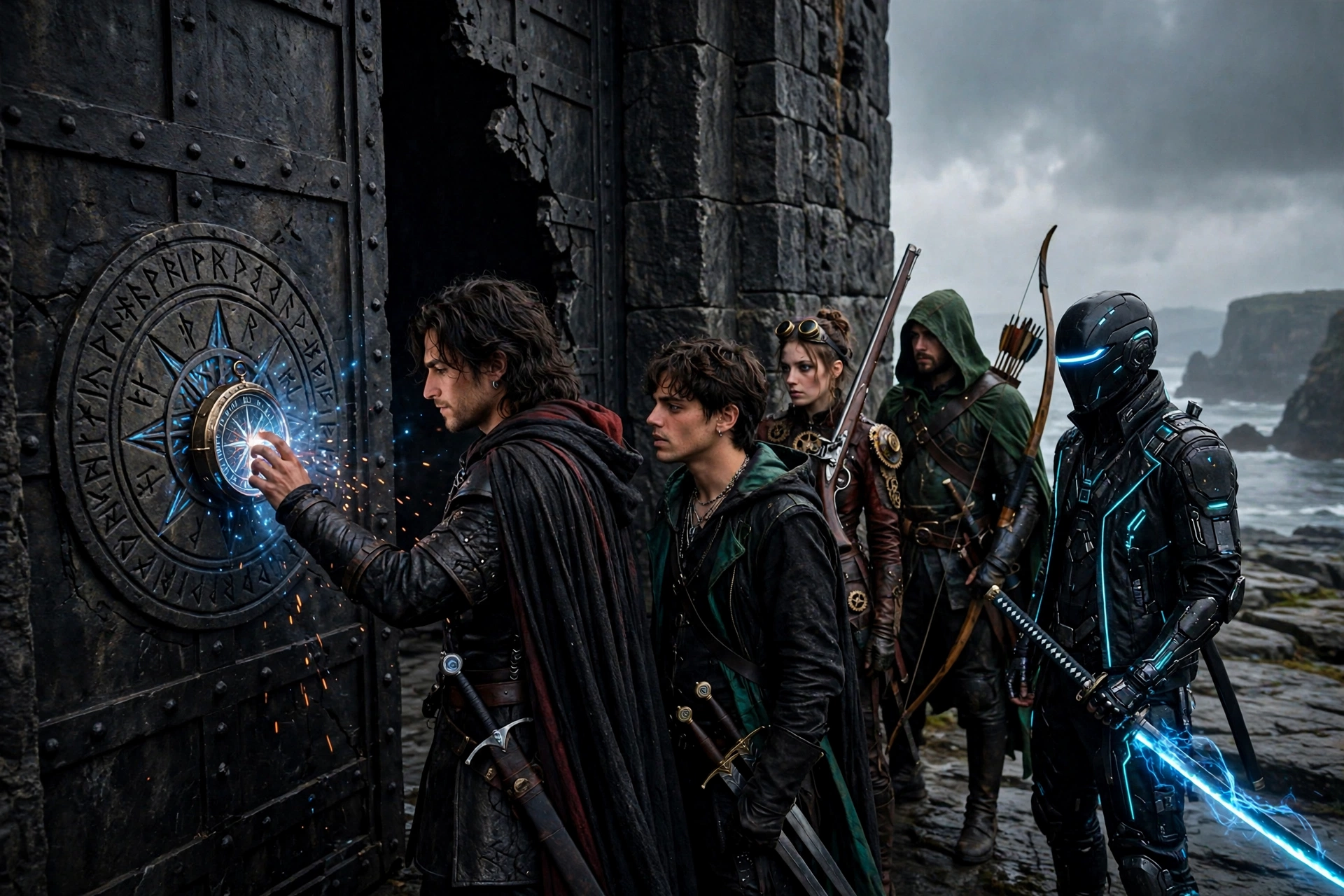
The tower door has no handle. No lock. No hinges I could see, no keyhole, no ring, nothing for a hand to take hold of. Just a circle, carved in black iron, a shallow round hollow worked into the middle of the door at the height of my chest — and the exact size of my compass.

I knew it before my hand moved. My fingers knew it. The compass came off its chain warm as a coal from my skin, and the carved circle seemed — I will swear this in any company — to lean toward it. Behind me I heard Vesper's rifle come up, heard the small clicks and shifts of my crew making themselves ready for whatever a door like that opens onto.

"Kaleb," I said. "You were going to tell me something, back on the path."

"Captain, that circle—" he began.

I set the compass into the carving.

It clicked. Deep in the iron, something fitted that had been waiting a long time to fit, and the whole door gave a shudder I felt through the soles of my boots. It turned on its own — the circle, the compass, both of them, rotating slow and certain under my palm like the hand of a clock arriving at an hour it had been promised.

And somewhere above us, high at the top of the tower, the light went out.

Not dimmed. Not shuttered. Out — the way a held breath is let go. The dark came down the tower over us all at once, and in that first black second the only sound in the world was the sea, far below, remembering how to be loud.

Kaleb was about to tell me something. He never got the words out.

Back to contents

Chapter Four — The Fight

Chapter Four — The Fight — illustration

Inside, the tower was a stair. That's all it was — a stone throat winding up into the dark, wide enough for two, with the smell coming down it that I will carry to my grave: cold seawater and old iron and something underneath both, sweet and rotten, like a harbour at low tide in a graveyard. We climbed. Rowan's bow creaked. Volt's light painted the wet stone blue, one step at a time.

Then the steps above us began to answer ours.

The tower keeps the Drowned. I had heard the stories the way you hear weather in another country — until that stair. They don't run. They climb. That is the whole horror of them and I won't dress it up: they come down a stair the way the tide comes in, without haste, because haste belongs to things that can lose. Water poured off them in sheets. Their eyes were open — open the way a drowned man's eyes are open, seeing nothing and missing nothing — and they took the steps one at a time, hands trailing the wall, patient as debt.

And my first crew was among them.

I knew the third one's coat before I knew his face. I knew the set of the shoulders on the fifth. Men and women I had buried in my heart a year ago, climbing down my stair with the sea running out of their sleeves. My sword hand went cold in a way that had nothing to do with the wet stone.

Vesper fired first. Her rifle cracked the stairwell open — the sound hit the stone and came back three times, and the shot is still echoing, somewhere in me, every time a room goes quiet. The front rank folded. The rank behind climbed over it without breaking stride.

"One!" Vesper called, working the action. "Stay off my line, Kaleb!"

"I'm not on your line, I'm saving your line!" Kaleb shouted back, ducking under a swinging arm. "There's a difference — it's called style!"

"Rowan — left!" I shouted.

"I see it," Rowan said, flat, and his arrow took the thing in the throat and pinned its reaching hand to the wall. "Left is handled."

"They're not slowing!" Vesper said. "Two! Three! Captain, they're climbing over their own!"

"Then make them climb higher!" I said. "Volt, hold that turn!"

"Holding," Volt said, and the blue of his blade filled the turn like a door.

We fought on the steps, steel and knees and elbows, Volt's blade a blue scythe in the choke of the stair, Kaleb in and out of the press like a needle. And then — in a gap, in a breath — one of them stopped in front of me. Not lunging. Not reaching. It stopped, with the water running off its chin, close enough that I could see the face I had toasted a hundred times across a table that no longer existed.

"No," I whispered. "You don't get to wear that face."

And it said my name.

Not the way the living say it. The way water says it, finding a crack. Behind me, Kaleb went very quiet.

"Captain?" he said. "Tell me that wasn't —"

"Don't listen to it," I said, and my voice shook despite me. "Whatever it remembers, it isn't him. Fight the hands, not the faces. You hear me? Fight the hands!"

Back to contents

Chapter Five — Finding Heather

Chapter Five — Finding Heather — illustration

Above the fighting, the stair ended at a door — and this door was worse than the one below, because this one I understood at a glance. The lamp room door was sealed from the outside. Barred from the outside, chained from the outside, with the chains gone green and the bar seated deep in its brackets like it had been dropped there and forgotten by whoever dropped it. Locks like that are not meant to keep anyone out. They are meant to keep something in, and to keep it in forever.

Whatever the Drowned lock away, they fear. I said it under my breath and heard Vesper say it again behind me, quieter, like a woman revising her arithmetic.

"It opens outward," Rowan said. "Whatever's in there — they wanted it where they could watch the door."

"Then let's disappoint them," I said. "Kaleb. Volt. With me."

It took three of us and the pry of Volt's blade and Kaleb's whole weight on the bar, and the door came open with a scream of old iron that set the dark inside it moving. The smell that rolled out was not the sea. It was lamp oil and cold ash and a room breathed in for far too long by one set of lungs. I went in first, sword up, eyes watering against the black —

— and found a sword already levelled at my throat, held perfectly steady, by a woman standing exactly where the dark was thickest.

We broke it open… and found a captain.

Heather. I knew her the way sailors know each other across any hell: by the stance first, then the tricorn, then the eyes, which had not gone dull or mad or anything the dark had clearly been hoping for. The Drowned took her ship. They took her whole crew — eleven souls, though I didn't know the number yet — and they had kept her in the dark at the top of this tower ever since, sealed in with the lamp like a coal they were afraid to let breathe.

She looked at my sword. She looked at my face. She lowered her blade by precisely one inch, which from her, I would learn, was an embrace.

She said nothing. That was the first thing — a year in the dark, and her first act in company was silence. She looked past my sword to the faces behind me and counted us the way a captain counts: slowly, once, no second pass needed. Whatever she made of the tally, her face kept it. Behind me, Kaleb started to say something and thought better of it. Nobody filled that silence. It was hers, and she had earned every second of it.

"Nobody sent us," I said at last. "We saw a light where no light should be, and we climbed." She gave no answer to that either. Her eyes went once to the lamp above us and came back, and whatever she knew about it, she kept behind her teeth.

Her first words to me, the ones I remember, were the ones she said as she finally lowered that sword all the way and stepped out of the dark to stand with us:

"You're late."

"You're alive," I said. "We'll argue about the timing later."

Back to contents

Chapter Six — Light It, Fast

Chapter Six — Light It, Fast — illustration

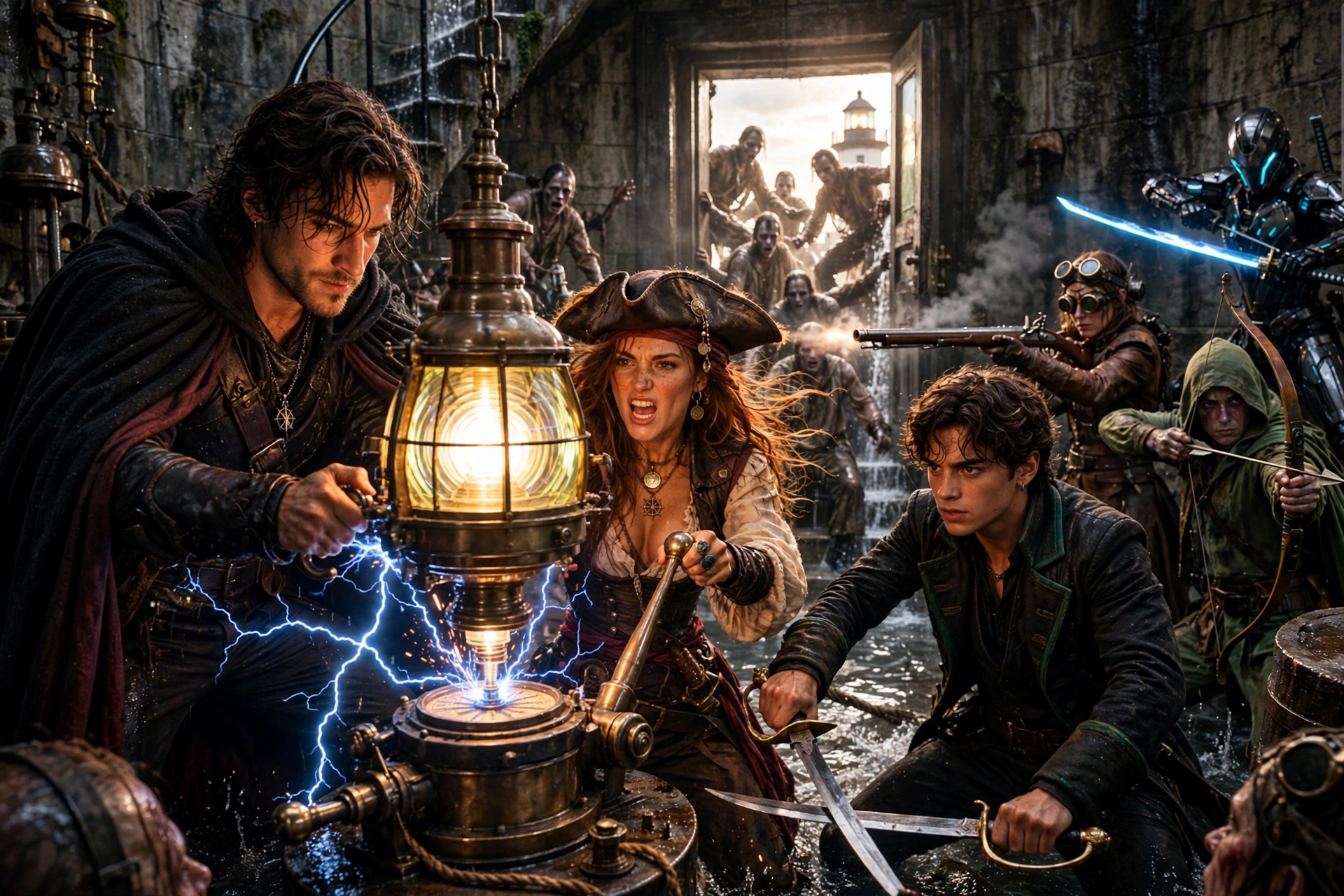
Here is what Heather told us in the lamp room, in the time it takes a wave to cross a deck, while the Drowned came up the stairs below: the lamp is a lock. Not a light for ships — a lock, on whatever sleeps under this island, and the great lens above us was its keyhole. The key was in my palm. My compass. It had never been a compass at all; or it had been a compass the way a key is a piece of brass — truly, and not the point.

The lamp is a lock. The key is in my palm. And the Drowned are coming up the stairs.

Heather was already at the lamp's base, hauling on an iron lever green with age, throwing her whole locked-up year into it. It didn't move. "Lever's stuck — give me your spark, Captain!" she shouted.

The compass was hot in my hand. I could feel it pulling toward the lamp the way it had pulled toward the door. "Kaleb! The door is yours!" I shouted.

Kaleb was already moving, both blades out, that grin of his that only ever showed up when the odds were indecent. "Already on it. Two blades, no waiting."

Vesper braced in the doorway beside him, rifle levelled down the stair, counting aloud for all of us because counting was her way of holding the line. "Six shots left. Make them climb over each other!"

Rowan was at the stair rail, shooting down into the press, unhurried as a man picking apples. "They don't feel pain. Aim for the knees."

And Volt took the doorway itself — the whole width of it, planted, katana lit and humming so loud now it sang. The Drowned hit him like water hits stone. "Doorway is a river. I am the dam," he said.

I drove the compass home into the lamp's heart as Heather threw herself on the lever, and the spark jumped from my palm like lightning looking for the sea.

"LIGHT IT, HEATHER — NOW!"

Back to contents

Chapter Seven — The Fight to Get Her Out

Chapter Seven — The Fight to Get Her Out — illustration

I have been asked since how we found her, as if the finding were the story. It isn't. We found her the way she wanted to be found: fighting.

The Drowned came up the stair behind us in their tide, and they came through the lamp room's broken door in a press of wet hands, and Heather met them the way a cliff meets weather — already moving, cutlass out, fighting with her back to the lamp she'd been locked in with, as if the room were hers now and they were the intruders. Which, I suppose, they were. She fought tired and she fought starved and she fought with a year of dark behind every stroke, and not one of those strokes was wasted. I took the left of the door. Volt took the right and made it a wall. Kaleb flowed through the gaps and closed them with other people's endings, and Vesper's rifle spoke over all of it, counted and calm: one — a space made; two — a space kept.

The Drowned took her ship. They took her crew. They should have taken her sword too. That was their mistake, and it was the kind of mistake that gets a tower full of dead men killed a second time. Somewhere in the middle of it she and I ended up back to back, turning slowly, and she said, conversational as a harbourmaster, "You fight like a man with a ship to get back to."

"So do you," I said.

"Then let's both be right."

Captain Heather, everybody. I have introduced her worse since, and never better.

When the press broke — and it broke, because even the Drowned can learn a room has teeth — I didn't waste the breath on a speech. I looked at the five of them, my five, and at her, and I said the only thing the night had left in it:

"Now we get her out of this tower — all of us, or none of us."

Back to contents

Chapter Eight — Getting Out

Chapter Eight — Getting Out — illustration

The lamp is lit. The tower is flooding. The stairs are a waterfall now.

I put it that plainly because that is how it arrived: not as a plan unravelling but as three facts, delivered all at once, in the time it took the light to fade from behind my eyes. The sea was coming up the tower from below faster than the tower was going down into the sea, and the spiral stair that had been our battlefield was a brown roaring throat of water, knee-deep, then waist-deep, dragging at our legs like hands.

Heather knew the way. A year locked in that tower and she had spent it learning every stone of it the way a prisoner learns a cell — with her whole attention, against the day. "Sea-door's below! I know this tower — follow me!" she shouted, and went into the falling water without hesitation.

"Kaleb, behind me — nobody gets left!" I shouted. He came in off the rear guard position with the water already at his waist, blades up out of the flood, grinning the indecent grin. "Running in water. My favorite speed."

Vesper went in cursing her rifle like a relative. "Powder's wet — I'm a swimmer now, not a shooter!" She held the weapon above her head anyway, out of the flood, because surrendering it to the sea was a thing her hands simply would not do.

Rowan, coming down last with an arrow still nocked out of pure habit, stopped at the turn of the stair and looked back up into the light. "The Drowned are running FROM the light," he said. "First good news all night."

Volt said nothing until the water was at his chest and rising, and then it was only: "Water rising. So are we. Move."

"Down!" I shouted, over the roar, as the stair gave a long shudder and the sea-door's groaning came up through the flood below us. "All of you — the sea can have the tower!"

Back to contents

Chapter Nine — Out of the Tower

Chapter Nine — Out of the Tower — illustration

The sea-door blew open — and the Drowned were waiting in the water.

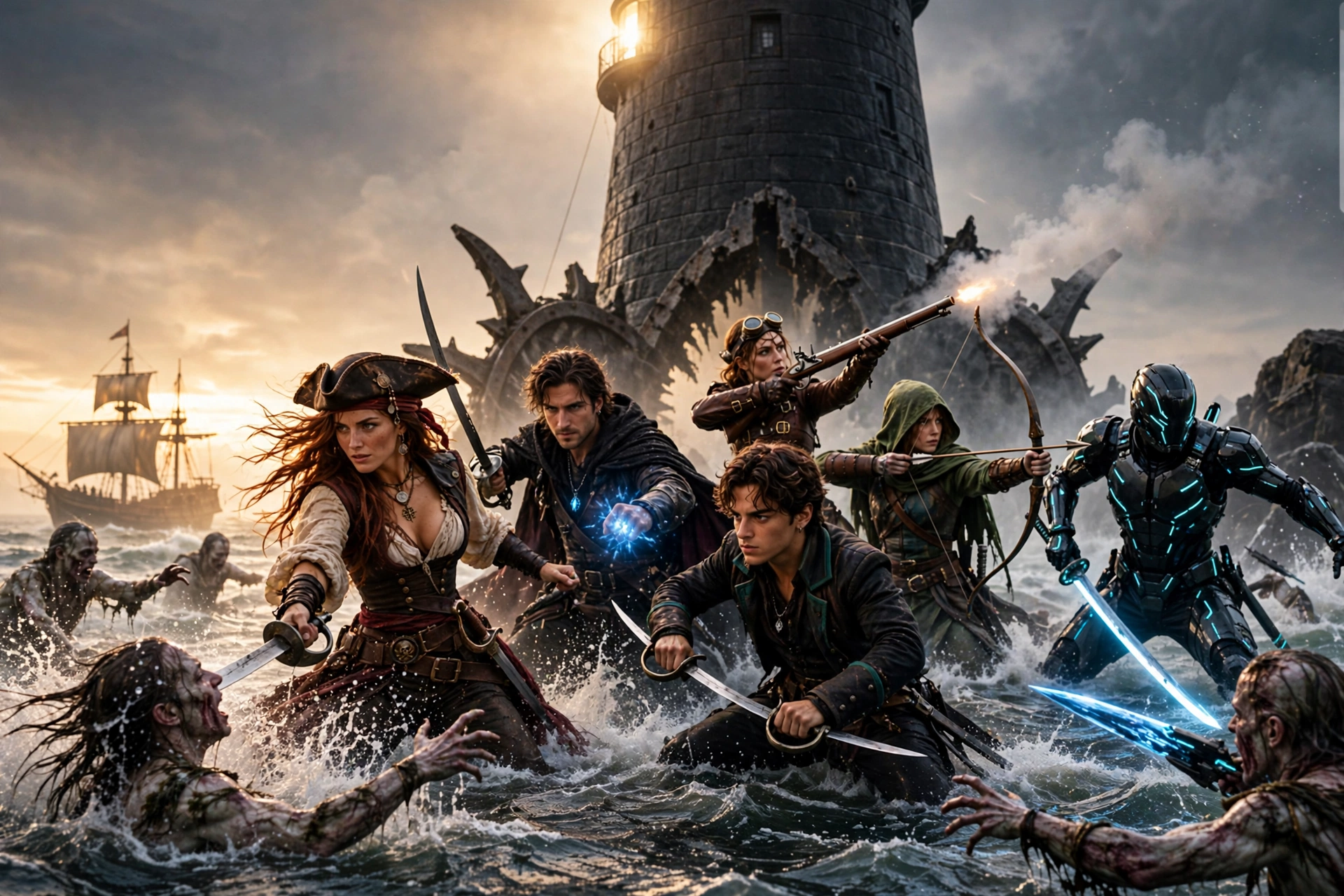
The door went out on a column of floodwater and we went out with it, into a harbour that wasn't a harbour: black water to the chest, rain coming down like gravel, the sinking tower behind us lit from inside by its own lamp, and between us and the ship — the ship, riding at anchor a hundred yards off with her lanterns swinging — a whole congregation of the dead, standing in the sea. They had fled the light. They had fled it straight into our road home, and there they stood, waist-deep, turning their open eyes toward us as the light behind them bloomed.

"Out! Out! Don't stop for anything!" Heather shouted.

I got the compass up out of the water, and it was already pointing — hot, certain, straight through the press of them. "Compass says the ship's that way — THROUGH them!" I shouted.

Kaleb shook the water out of his eyes and set his feet like a man about to enjoy himself. "Then we go through. Blades first."

Vesper racked her rifle's lock clear with two fingers and teeth, a shooter's trick for bad days. "Dry powder or not — I only need one shot!"

"Left side!" Rowan shouted. "They're climbing over each other!"

They were — piling toward us on the left where the water was shallower, and that was when Volt stepped past me into the front of it, visor lit, blade lit, and said the thing I have quoted to every crew since: "Six of us out. Six of us reach the ship. No other math."

We went through them. I will not make it pretty: it was wading and cutting and shoving, cold hands catching at coats and wrists, Heather's cutlass work on my right like a second heartbeat. And when we broke through the far side of them into open water, Heather looked back at the whole soaked, swearing, bleeding family of us and laughed out loud.

"That's my kind of crew!"

Back to contents

Chapter Ten — The Lamp Catches

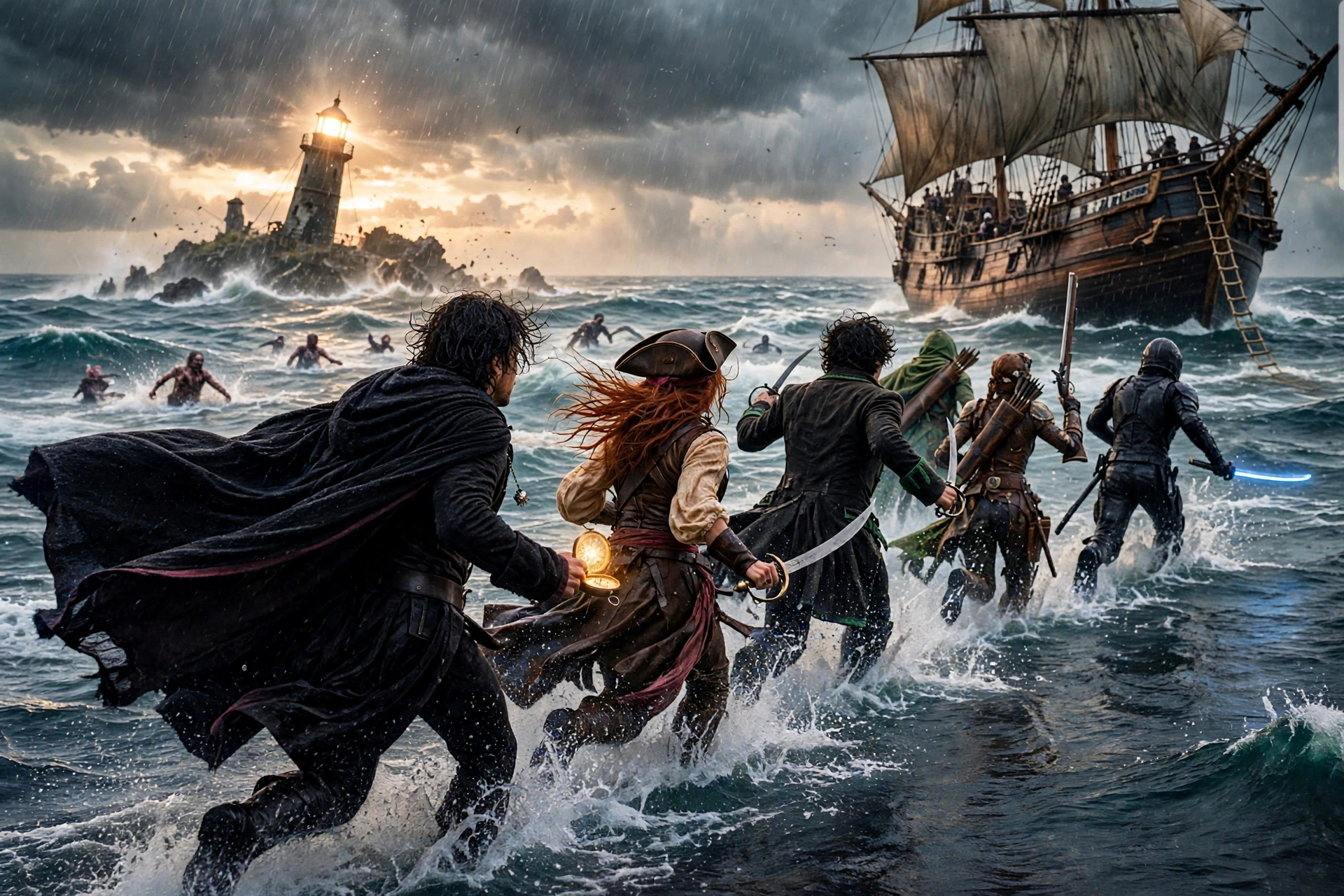
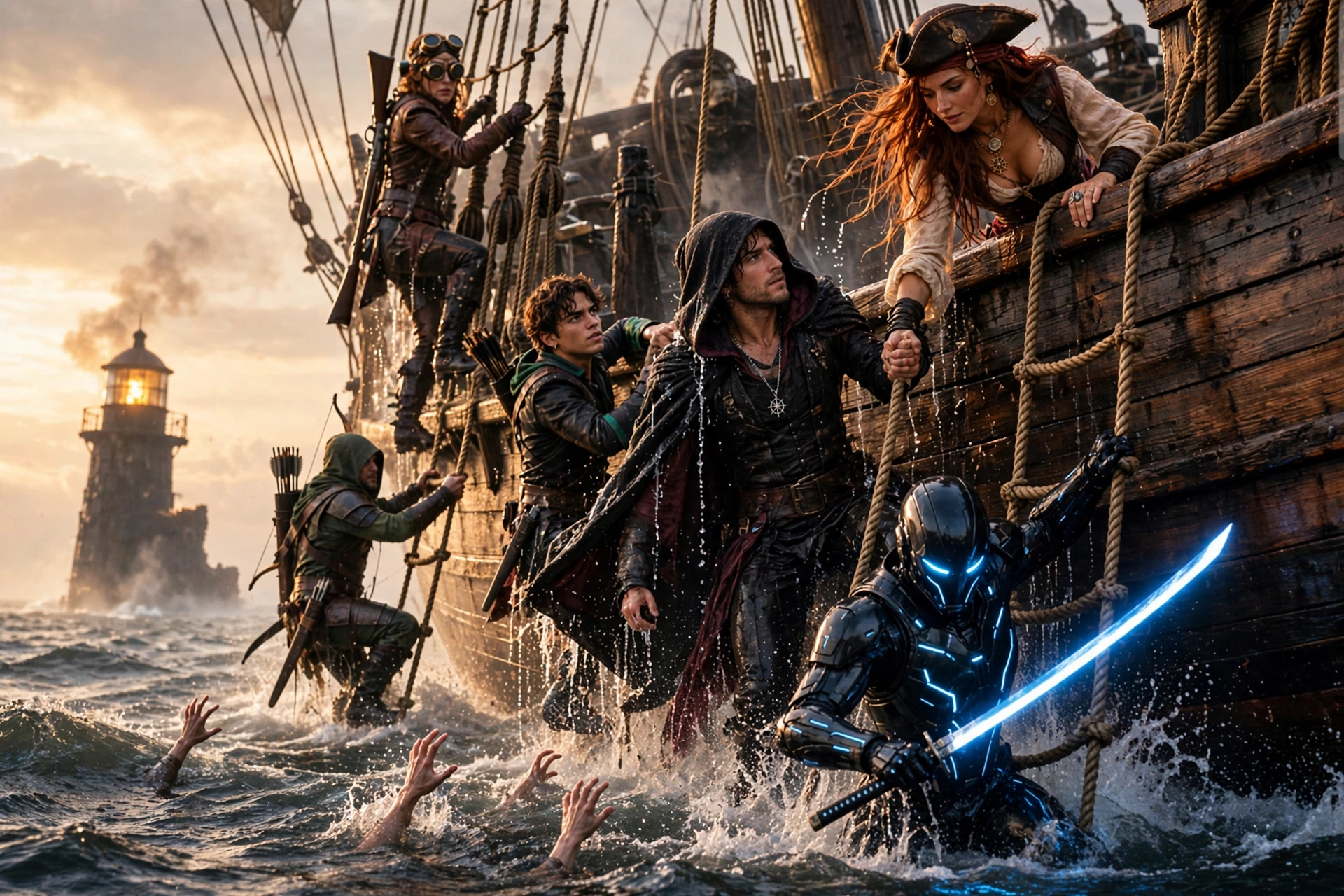
Chapter Ten — The Lamp Catches — the crew running through the surf for their ship, seen from behind, in their Part One clothes: the Captain in his heavy matte-black hooded cloak from Part One, plain black with only a thin dark burgundy edge to the lining, holding his compass, Heather in her tricorn with cream blouse, brown corset and red sash, Kaleb in black with emerald trim, Rowan in his green hooded cloak, Vesper with her rifle held high, and Volt in matte black armour and his closed helmet, the lit tower sinking behind them

The lamp caught.

I have seen lightning strike the sea at night and I have seen a powder store go up, and I am telling you the lamp catching was neither of those. It was a wave. The light went out like a wave — rolling off the tower in every direction at once, through stone, through fog, through the wet ranks on the stairs, so bright it printed the bones of my hand on the inside of my eyes. And the Drowned fell back into the sea, hands over their eyes — the whole climbing tide of them, stopped, blinded, clawing at faces that had stared open through a year of drowning. They went back the way water goes back: all at once, and with a sound like the whole island sighing.

One second of silence. I counted it. One second, the first true quiet since we'd landed.

Then the island started to sink for real.

You feel a thing like that in your knees before you hear it — a long groan through the stone, the tower shifting its weight, dust coming off the lamp-room walls in sheets. The floor listed under us by a degree, then another.

"RUN!" I shouted. "Ship — now!"

Heather was already moving, a year of captivity burned off her in one stride, though she laughed once, breathless, as the stairs tilted. "My legs remember dry land. Barely."

Kaleb went past me in a blur, taking the steps three at a time, calling back over his shoulder, "Less talking. More running."

We ran. Down the drowning stair with the water already finding the cracks, out across the yard, down the path where the footprints had been — and we made the water as the beach disappeared behind us, the black shingle sliding away into the surf like a tablecloth pulled by the sea.

Behind us, the tower's light still burns. Under us… something just opened its eyes.

Back to contents

Chapter Eleven — To the Ship

Chapter Eleven — To the Ship — illustration

Six went into the tower. Six came out. The sea tried to change the count at the rope ladder.

The ship loomed over us out of the rain, hull black and streaming, and the rope ladder came down her side like something lowered out of heaven by a drunk angel — swinging, twisting, the rungs slick as eels. The swell kept taking it away from our hands and giving it back. Below us the water was full of the Drowned, drifting now, scattered by the light, but their hands still rose out of the dark at whatever passed within reach, slow and certain as things that have never once been refused.

Heather got to the ladder first and went up it the way she'd done everything that night — like the tower had been a year of training for this one climb. Halfway up she stopped, braced, and reached back down into the mess for me. "Hand! Give me your hand, Captain — I've got you!"

I got Kaleb by the coat and boosted him at the rungs. "Kaleb, climb! Don't look down!"

"I'm not looking down," he said, through his teeth, going up hand over hand with his eyes fixed somewhere above my head. "I'm looking at the hands looking at me."

Then Vesper, from the water beside me, in a tone that permitted no discussion: "Volt's still in the water — somebody haul!"

He was. Last in the sea, as he'd been last at the door, holding the ladder's foot steady against the swell with one hand and watching the Drowned drift with his blade lit low in the other. I hauled on the ladder and Heather hauled on me, and he came up out of the black water in a sheet of it, armour streaming, and looked back once at the sinking tower.

"Last one out," he said. "First one they'll tell stories about."

Rowan, already at the rail, was watching astern, where the tower's top went under in a boil of steam and foam. "The tower's going down behind us… look at that light," he said.

It burned all the way under.

Back to contents

Chapter Twelve — The Wheel Is Yours

Chapter Twelve — The Wheel Is Yours — illustration

We sailed out with one more captain than we sailed in with.

The storm took us off the island the way a hand takes a cup off a table — roughly, and without asking — and for the first hour out I did nothing but work the ship and listen to her settle into being underway again: canvas, cordage, the hull finding its rhythm under us. Then I went to the wheel, where Vesper had been standing double watches without complaint, and I did the thing I'd been turning over since the lamp room.

"The wheel's yours," I said to Heather. "Your hands know storms."

She looked at me a moment — a year in the dark at the top of a tower, and I'd known her for one night of it. Then she took the wheel with both hands, and the ship answered her like a horse answers a rider it remembers. "A year on a borrowed sea," she said quietly. "I almost forgot the feel of her."

Kaleb, sprawled by the mast with his daggers across his knees, grinned up at the two of us. "Two captains, one ship. What could go wrong?"

"Ask me after I've slept a week," said Vesper, from the rail, without turning around.

It was Rowan who said it last, standing aft with his bow grounded, looking back the way we'd come. "The light's still burning — under the water."

We all looked. The island was gone. The tower was gone. But there, beneath the surface, in the deep water astern of us, a light burned — steady, patient, and impossibly far down.

"A lock that burns beneath the sea," said Volt, at my shoulder. "Filing that under: unfinished."

My compass was quiet for the first time in a year. I felt it through my shirt, cool and ordinary, and I let myself believe the night was done with us.

Then it turned. Slowly. Back toward the light.

Back to contents

Stormhaven

Part Two

Dead Man’s Reef

Chapter One — The Confession

Chapter One — The Confession — illustration

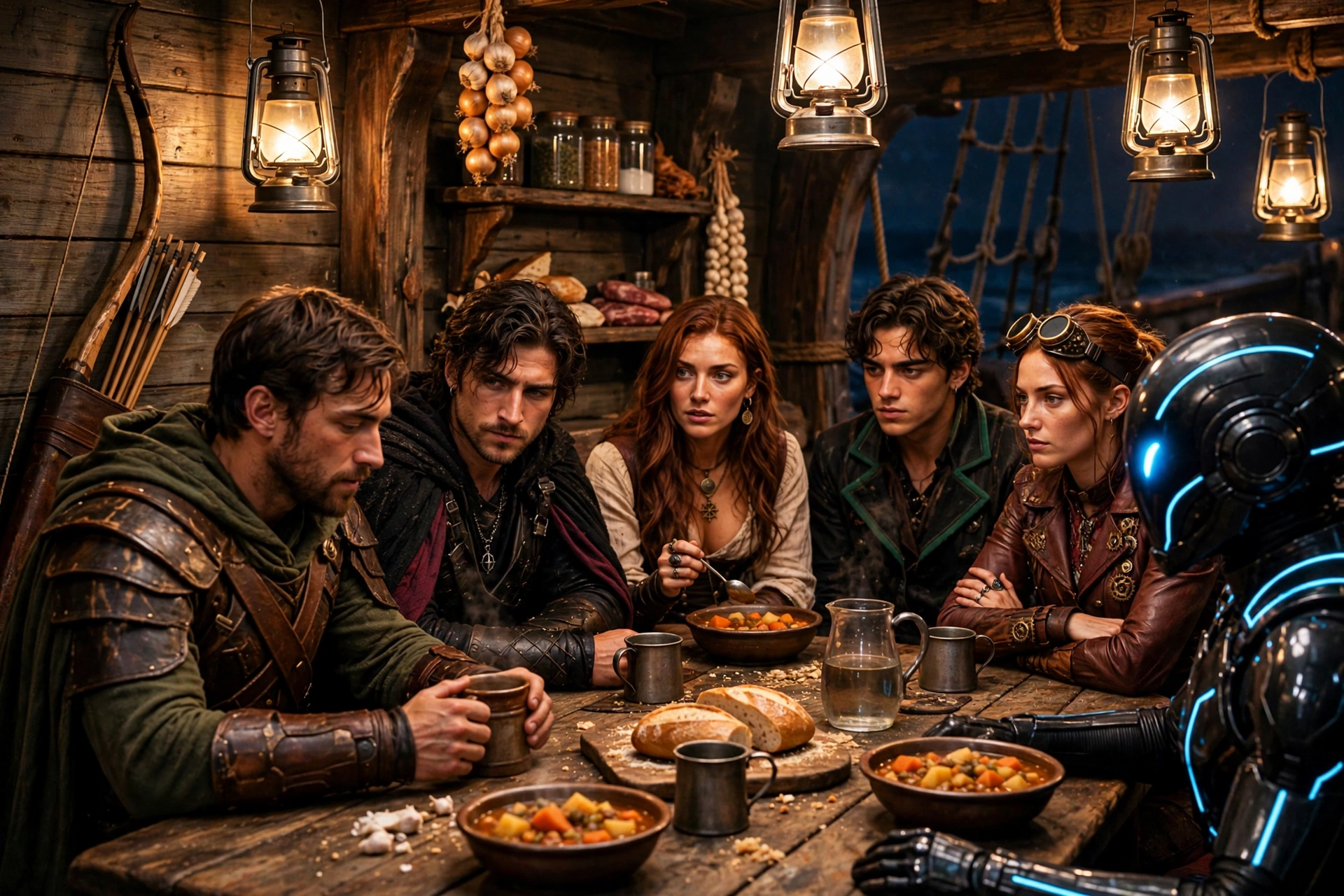
Supper in the galley, and for a while it was only that. The lantern swung with the ship's breathing, the bread was still warm from the oven, and the steam off the stew mixed with tar and salt and the smell of the sea coming through the seams. Six of us around a table built for four, knees knocking, passing the pot hand to hand. After the tower, after the lamp and the stairs and the dark, it felt almost ordinary — and ordinary is a thing a crew learns not to trust, but to enjoy while it lasts.

Rowan ate like he always ate, in silence, his bow leaning on the wall beside him where his hand could find it without looking. He never lets that bow get far from him. None of us thought anything of it. Then he set his mug down — carefully, the way a man sets down something he has decided not to pick up again — and the whole table felt it before he spoke.

"The Drowned aren't the sea's," Rowan said. "They're my village's dead. And the man who rings for them… is our chief."

Heather's spoon stopped halfway to her mouth. "Your chief," she said. "The one who sent them at my ship."

"Him." Rowan didn't look up. "I was his watcher. The night the Captain's ship went down, the bell I rang wasn't a warning."

I heard my own voice come out quieter than I meant it. "What was it?"

Rowan raised his eyes then, and met mine, and gave me the word like a stone laid on the table between us.

"An aim."

Nobody ate after that. The lantern swung. The ship creaked around us, and somewhere below the waterline the sea went on about its business, and everything I thought I knew about the night my first ship died quietly turned over in the dark.

Back to contents

Chapter Two — The Map

Chapter Two — The Map — illustration

The galley went quiet enough to hear the wick burn. We were all doing the arithmetic at once — Rowan's bell, Rowan's chief, the Drowned walking out of the sea with orders in them like orders in a letter. It should have sunk the evening. Instead, Heather laughed — once, short and bright, the way she laughs when she's been holding a card too long — and reached into her coat.

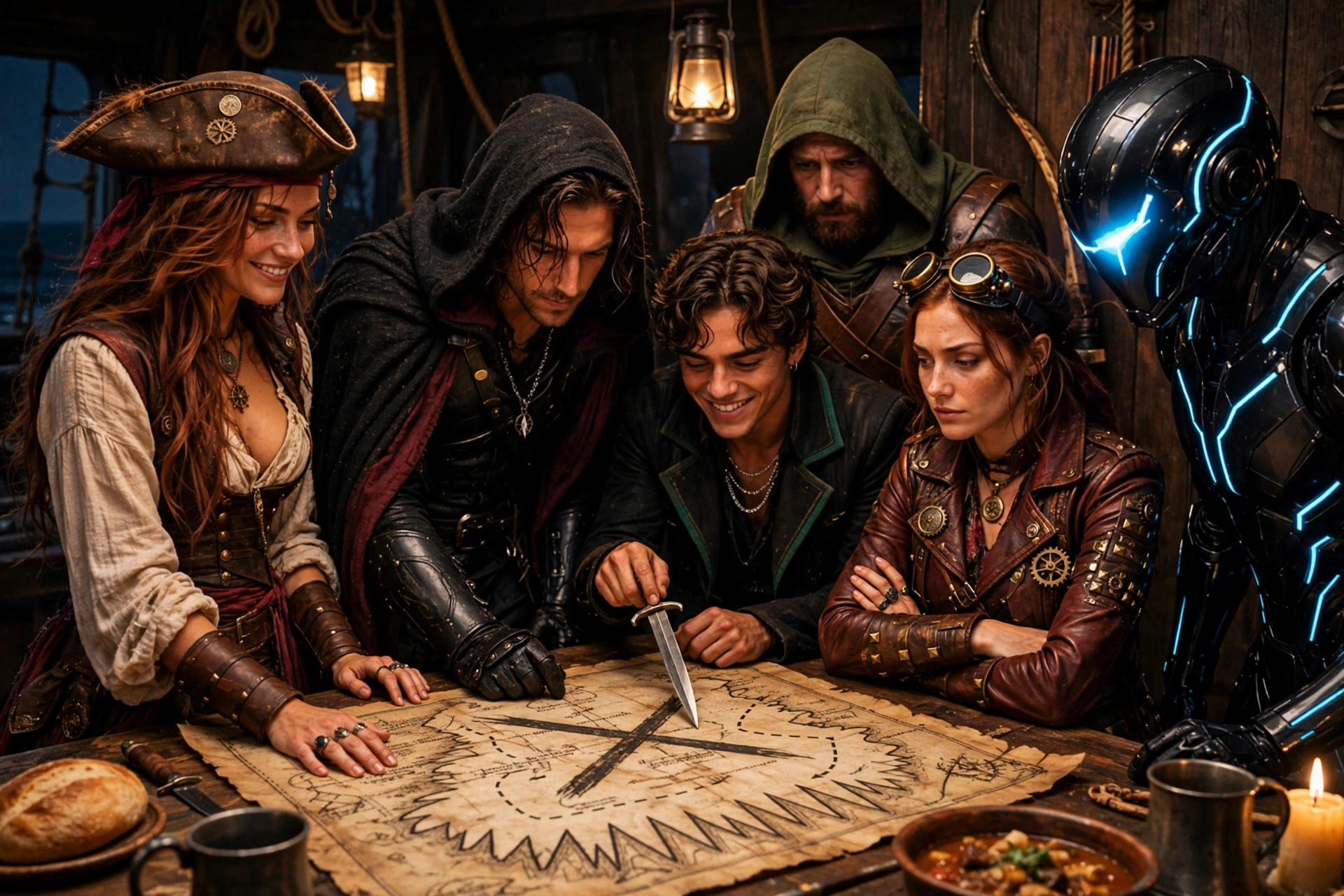
She unrolled a map across the supper table, right over the bread and the cooling stew, and weighted the corners with mugs. The parchment was salt-stiff and older than any of us, inked with a coastline I half recognised and a reef drawn like a mouthful of broken teeth.

"Little do you know," Heather said, "that I have the lost treasure map of Dead Man's Reef."

Kaleb leaned in over the parchment, and I watched the rogue in him sit up and take notice before the sailor did. "Now the supper improves."

Rowan's face had gone the colour of old ash. He knew the name the way you know the name of the water you nearly drowned in. "Dead Man's Reef… That's where the taken ships end up. Everything the Drowned strip, the sea keeps there."

I looked at the X, inked hard enough to scar the page, sitting in the middle of that drawn lagoon like it had been waiting for us personally. "Whose treasure is it, Heather?"

She smiled then, and it wasn't a kind smile. It was a captain's smile, the kind that has a crew list folded inside it.

"Everyone's he ever robbed," she said. "Ours included."

Eleven names she carries. A ship of mine on the bottom. Whatever else that reef held, it held what was ours — and I understood, looking round that table, that we had just stopped running from the Chief's sea and started sailing into it on purpose.

Back to contents

Chapter Three — The Full-Moon Tide

Chapter Three — The Full-Moon Tide — illustration

Two days of sail, and Heather steered us like she was born on that map. She took the wheel for long watches and barely glanced at the parchment — she'd had a year to dream this coastline, locked in a lamp room with nothing but her own memory of it, and the dream had kept the soundings better than ink could. The wind held fair. The sea stayed that flat, watchful grey that makes sailors talk low without knowing why.

The channel through Dead Man's Reef opens only at the full-moon tide, when the water rises high enough to float a hull over the teeth. Miss it, and the teeth take the hull — there is no second tide, no waiting it out at anchor in those waters. So we worked the ship like a thing with an appointment. Sails trimmed and re-trimmed. Soundings called. Everything loose made fast.

Vesper went through the stores with her list and her pencil stub, twice over, and reported to no one in particular: "Loads counted. Twice."

Kaleb, coiling a line with more flourish than the job wanted, considered the reef on the horizon. "If this goes wrong," he said, "I want it noted I looked great."

It got a laugh — a small one, but real. Then Rowan, at the rail with his face to the wind, said one word.

"Listen."

We listened. Under the wind, under the creak of the rigging and the slap of water on the hull, there was something else. Under the water, far below the keel — one bell. Once.

A single note, deep and slow, travelling up through the whole length of the ship and into the soles of my feet. Nothing on the surface had rung it. Nothing we could see had moved.

As if something down there had just been told we were coming.

Back to contents

Chapter Four — Through the Teeth

Chapter Four — Through the Teeth — illustration

Full moon. One hour of tide. No lamps. No voices.

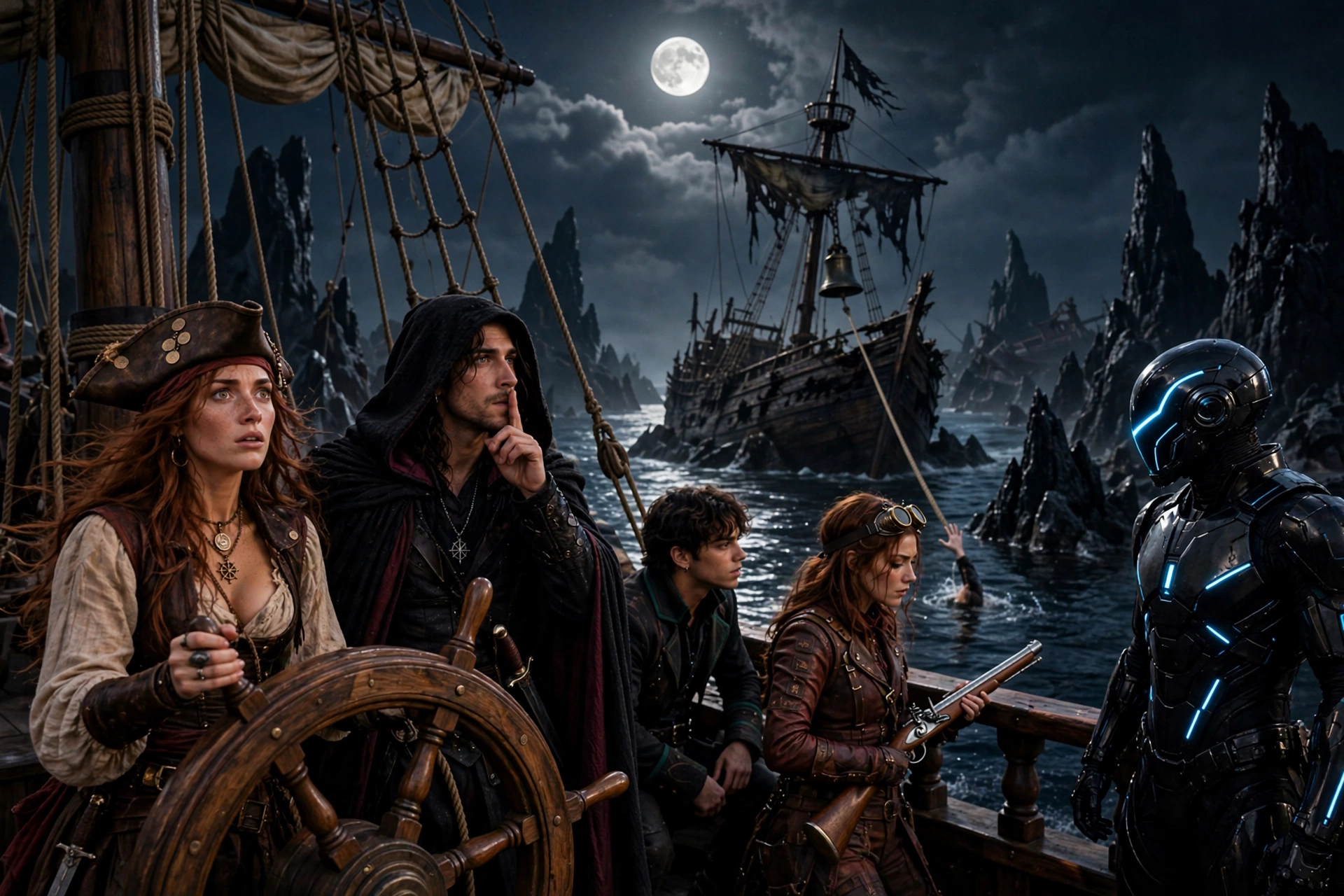
We went in dark and silent, the moon laying a road of hammered silver on the water and the reef showing black against it — teeth of rock and coral in long broken rows, some awash, some standing taller than our mast. The tide lifted us and carried us between them at a walking pace, and I steered by Heather's hand on my shoulder: pressure left, pressure right, a grip that meant stop with my heart in my mouth.

On both sides, the taken ships. Hulls canted on the teeth, masts gone or leaning, their bells hanging in the rigging over black water — silent, all of them, the way bells in a drowned church are silent. Everything the Drowned had ever stripped had passed this way. I did not let myself count the wrecks. Counting is a kind of naming, and I did not want anything down there to learn our names.

Then Heather stopped breathing.

Her hand went iron on my shoulder, and her voice came out thinner than I have ever heard it. "That's her. That's my ship."

Impaled on the tallest tooth, high out of the water, sat Heather's ship — canted, broken-backed, unmistakable. Her skull flag still flew at the masthead, faded to grey, snapping in the night wind over a deck where eleven people had died on a chief's orders. Eleven names I now know by heart, because Heather says them the way other people say prayers, and I have listened.

And under her hull, where the shadow of the wreck met the water, something moved. A hand came out of the sea — pale, unhurried, certain of its work. It took her bell rope.

And rang her bell once.

The note rolled over the reef, clear and deliberate, and died away into the moonlight, and every one of us understood it for what it was: a door being knocked on, from underneath.

Back to contents

Chapter Five — The Grandsire

Chapter Five — The Grandsire — illustration

The bell on Heather's wreck was still swinging when the water beside us stood up.

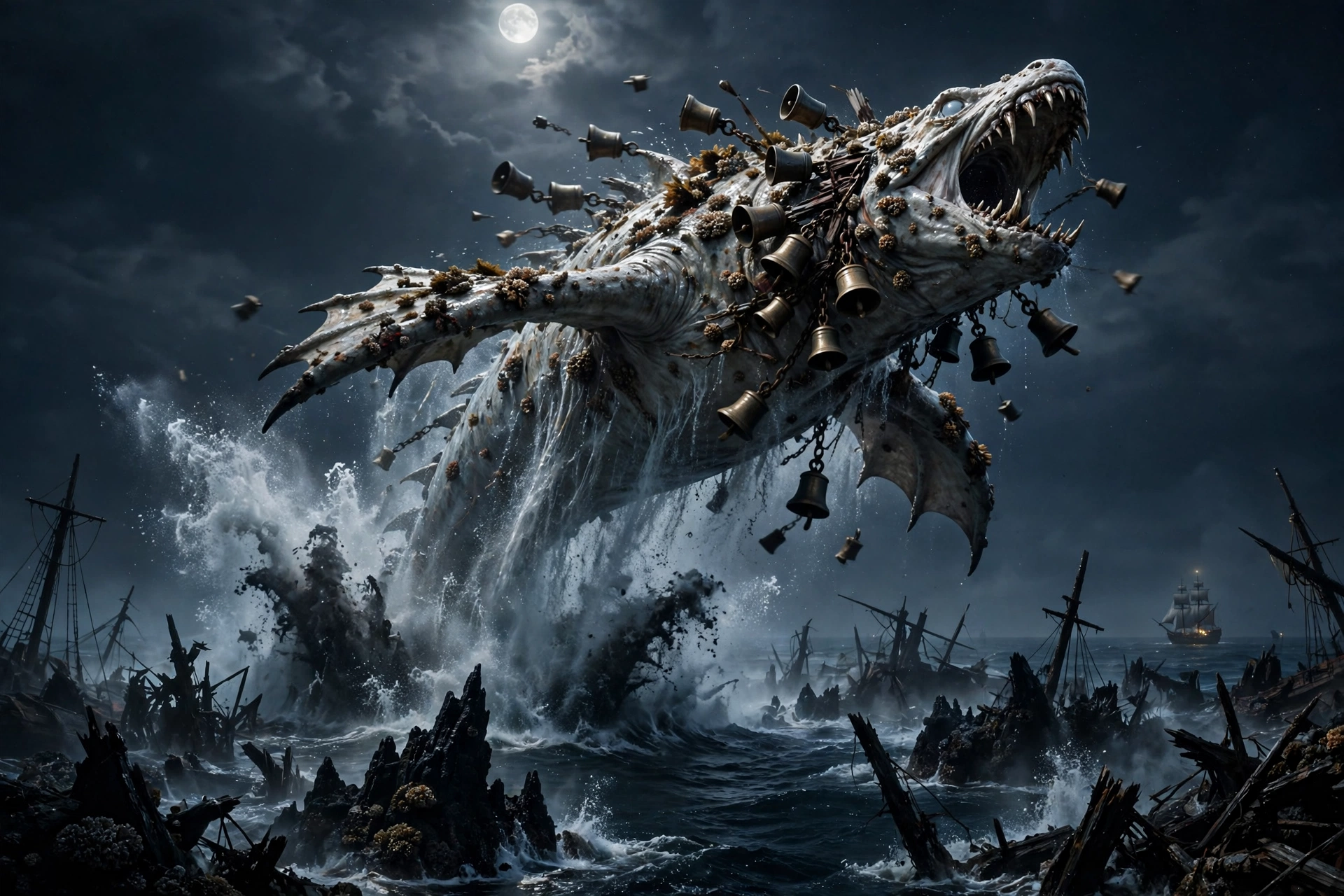
I have tried since to find a way to say it plainly. The sea rose. Not a wave — a rising, the way a hill rises out of a plain, except this hill was alive and it kept coming: a back out of the black water broad as our deck, streaming and shining in the moonlight, coral and barnacle and old wreckage grown into the hide of it, and along that hide, bell after bell after bell, fused into the flesh like stones in a wall.

The Grandsire. Older than the reef. Blind as the deep. Its head came up last, swinging slow, and the eyes in it were milk-white and sightless, and the mouth under them was ringed with teeth like broken masts. A hundred ships' bells wore into that hide chimed, soft, as it rose — a drowned music, almost gentle, and that was the worst of it.

Every bell the Chief ever tolled had fed it. Every tolling night, every taken ship, every crew the Drowned stripped — the bright things, the brass and bronze and silver of them, slept in its nest at the bottom of the reef, and the thing itself had grown fat and ancient on the sound of other people's endings. The hand that rang Heather's bell had not been a greeting. It had been a summons to the table.

It cannot see us. That is the one mercy in its whole enormous body: it hunts by sound alone, and it was tasting the water for us now, turning that blind head the way a dog turns into a wind.

"Nobody breathe loud," Heather whispered, so soft I felt it more than heard it. "Nobody pray out loud either. Not tonight."

"I wasn't praying," Kaleb whispered back. "I was negotiating."

"Kaleb," Vesper breathed. "If your negotiation makes a sound, I will shoot you myself and save it the trouble."

"Noted," Kaleb said. "Silent negotiation."

Rowan's whisper came last, from the bow, flat and certain. "It's listening for a hull. For a heartbeat in wood. Be wood."

"Be wood," Volt repeated, barely a sound at all. "Copy."

Nobody on this ship breathed. Oars shipped. Sails slack. Six hearts, and I could hear every one of them, and prayed the thing below the waterline could not.

Back to contents

Chapter Six — The Fight

Chapter Six — The Fight — illustration

It had us. Silence bought us perhaps a dozen heartbeats, and then a bell somewhere in its hide caught the sway of its turning and chimed against another, and the great blind head swung toward the sound of our hull with the certainty of a compass needle. So we fought.

The deck went from held breath to uproar in a single second, and every voice I own was in it at once.

Vesper was already at the rail with her rifle up, shouting the gunner's gospel: "Aim for the bells — make it deaf with its own music!"

Rowan had an arrow on the string and his eyes on the one target that mattered, calling for his shot like a man calling for room to work: "Eye socket! Give me one clear—"

Heather had the wheel and the whole straining ship in her hands, fighting the current that was dragging us toward the teeth: "Hold her steady, you bastard, hold her—"

Volt's voice cut through all of it, flat and certain, counting down the thing bearing on our hull: "Hull impact in three. Two. One—"

And Kaleb, daggers out, grinning the grin he wears when the world finally moves at his pace: "Finally. A fight at my speed."

Rowan's arrow found the eye socket. And Vesper's shot took the great bell on its brow — the largest of them all, big as a chapel bell, fused into the bone above those white eyes. The rifle's crack rolled out over the reef, and the bell split its note into the night.

The sound that came out of the Grandsire wasn't a roar. It was older and worse than a roar; it was pain in a throat that had never needed one.

And every bell on every wreck in the reef answered. A hundred drowned bells, tolling all at once in the dark — and us in the middle of the music.

Back to contents

Chapter Seven — The Trouble

Chapter Seven — The Trouble — illustration

We won the fight. Then we counted the trouble, and the trouble took longer.

The Grandsire, wounded — Rowan's arrow standing in its eye socket, Vesper's shot in the great bell of its brow — had sounded and fled into the deep water, and its going had been an earthquake in the channel: the way behind us had collapsed in its wake, rock and coral grinding down into the passage we had entered by. We were not sailing out the way we came. And the hull was holed below the waterline from the grinding we'd taken against the reef, and the lagoon we'd been carried into was shallowing under us. We beached her, in the end, on the lagoon's shore — holed, heeled, and going nowhere.

The Grandsire was below us somewhere, out in the black water off the beach. Wounded. And remembering — a thing that hunts by sound does not forget a voice, or a hull, or a rifle's crack.

At the lagoon's edge stood the other trouble. The reef-wide tolling of the fight had called the Drowned, and they had come: a ring of them in the shallows all along the shore, standing in the water up to their knees, up to their waists. Watching. Not advancing. I have seen the Drowned hungry and I have seen them at their work, and this was neither. This was a garrison, waiting.

Vesper came up from below with her hands black with tar and her verdict ready. "She'll float patched. Two days."

"Two days if we work," Heather said. "Three if we argue about working."

"Then I vote we skip the arguing," Kaleb said. "For once. Mark the log."

"You'll work rigging," Vesper told him. "And you'll like it."
"I like nothing at this height before breakfast, but go on."

"What about the way out?" I asked.

"Gone," Rowan said. "Channel fell in behind the Grandsire. We go out another way, or we don't go out."

"There's always another way," Heather said. "It's just usually worse. That's how you know it's the way."

Rowan was looking at the ring in the shallows, not at the ship. "They're not waiting for the ship."

"No," I said. "They're waiting for orders."

"Then let's not keep them waiting for ours," Heather said. "The hoard first. Proof first. Then we talk about sailing through a wall."

Trapped, then: a holed ship, a collapsed channel, a wounded god under the water and a silent army standing in it. But the X on Heather's map was across this lagoon — the hoard, the proof, everything the Chief ever stole. We were trapped, all right. Trapped in exactly the right place.

Back to contents

Chapter Eight — The Hoard

Chapter Eight — The Hoard — illustration

We crossed the lagoon in the chaloupe, the ship's small boat, rowing soft over water the colour of slate — the ship herself beached and holed behind us, with Vesper staying aboard to patch her and guard her, her rifle across her knees. The great wreck of the cove, the ship at the map's X, lay ahead with her hoard spilled through her opened side, and the ring of the Drowned stood in the shallows the whole way, watching us pass like mourners at a road.

Rowan shipped his oar and spoke low. "They're watching us. Nobody splash."

The hoard was real. Even knowing what it had to be — a generation of stolen cargo, everything stripped from every taken ship — the scale of it stopped my breath: chests swollen with seawater, goblets and plate crusted green, coin, gear, keepsakes, and a hundred ships' bells stacked like eggs in a nest, each one a vessel, each one a crew. Heather went straight past the gold. She knew what she had come for.

"My strongbox," she said. "My log… a year under water." Her hands were shaking on the swollen wood. "Captain — the last line isn't in my hand."

I read it over her shoulder, later, in dry ink on the last page: a Tollkeep clerk's neat receipt for her ship and her eleven souls, written in her own log like a signature on a bill of sale. Proof. The kind that hangs a chief.

Kaleb, meanwhile, had gone quiet in the way that means he's found something. "Forget the log, look at this dagger. It's the twin of mine. Wait — why is mine leaning toward it?"

His own dagger, at his belt, was straining toward the found blade like a needle toward north. Volt's voice came flat and fast. "Do not let them touch."

"Kaleb, don't—"

Too late. The blades kissed. One true note rang out over the whole lagoon — and every Drowned head turned.

Back to contents

Chapter Nine — The Signal

Chapter Nine — The Signal — illustration

For one held second nothing moved — and then the whole ring of them started toward the wreck, wading, unhurried and certain, and I could hear the water rising off them in sheets. It was Rowan who understood first. Rowan, who had been a watcher, who had rung the bells of this coast and knew what the notes were for.

"Old watch-codes!" he shouted. "Three notes — STAND! Ring it, Kaleb!"

Kaleb stared at his daggers like they'd betrayed him — which, in fairness, they had. "I'm a rogue, not a church—"

"RING IT." I put the whole deck of my authority into it, and Kaleb, for once, didn't argue with the tone.

He struck the blades together — once, twice, three times, the old code for stand, for hold, for halt where you are — and the daggers sang. The note went out over the lagoon like a hand laid flat on the water. And the whole lagoon stopped. Every Drowned froze mid-step in the shallows between the wreck and our beached ship, water still moving around legs that no longer did. Men and women of a dozen drowned crews, standing like statues in a flooded churchyard, held by three notes of a code older than the Chief's use of it.

From the deck of the beached ship, Vesper's rifle started counting her shots — one, spaced, deliberate, one — laying cover over our row back, each crack an argument for anything in the deep water thinking of rising.

We rowed through a forest of the standing dead. Every Drowned stood still.

Every one but one. He kept walking. Through the shallows, against the code, against the bells, straight at Kaleb with his hand out — not for the boat, not for any of us.

For his dagger.

Back to contents

Chapter Ten — Jonah

Chapter Ten — Jonah — illustration

We could have rowed. I want it written down that we could have — the boat was under us, the ship behind us, Vesper's rifle counting away the seconds. Kaleb looked at the walking man, at the outstretched hand, at the dagger in his own fist that was leaning toward its brother like a dog toward a home it remembered. Then he stood up in the chaloupe, stepped over the side into the shallows, and walked out to meet him alone.

Hands open. The found dagger held out by its blade, hilt first, the way you return a weapon to its owner — or offer your throat to it. An arm's length from the dead man, Kaleb spoke, and his voice was not the rogue's voice. It was younger, and it was honest.

"I carried mine a year, not knowing it had a brother. This one's yours. It always was."

The drowned man's fingers closed on the hilt. The runes along the blade lit — a slow fire running the length of the bronze, waking letter by letter. And his eyes, which had been lagoon-water and vacancy, changed. Cleared. Focused, the way a man's eyes focus when he surfaces from deep water and remembers there is air.

"…Jonah," he said. His voice was rust and disuse, a voice a year under the sea. "I was Jonah."

A name. The first of the Drowned to give us back a name — a person, standing in the wreckage of the Chief's whole design, holding proof in his hand that the design had a crack in it.

Then, far away across the water, from a tower none of us could see, the Tollkeep bell tolled once.

And Jonah turned with all the others, and walked back into the deep.

Back to contents

Chapter Eleven — The Flight

Chapter Eleven — The Flight — illustration

You should have seen him flee.

That is what I keep coming back to, in the quiet watches: not the size of him rising, God knows we'd seen that, but the size of him leaving. A mountain departing the sea, breaching clear in the moonlight with the water falling off him in curtains, bells ringing off his hide like a church falling up into the sky — a hundred bells, all the drowned music of him, sounding at once because there was no part of him that could move without ringing.

Then Rowan's arrow took him in the eye socket. Vesper's shot took the great bell on his brow. And he ran — if a thing that size can run. The sea closed over him like a country closing its borders, and the reef shook with his going, and the channel we'd come by shook itself to rubble behind him, and that was the fight: not won, exactly. Survived, with the monster's memory for a trophy.

"There he goes," Kaleb said, breathing hard, one hand pressed to his ribs where a spar had caught him. "Tell me someone else saw that. Tell me I didn't imagine a mountain leaving."

"We saw it," Vesper said. She was reloading without looking down, eyes on the water. "I'm still seeing it. I expect I will be for a while."

"Is he dead?" Heather asked.

"No," Rowan said. "Wounded flees. Dead sinks. That was fleeing, Captain. Fast fleeing."

"Good," Heather said. "Let him tell the deep what happened here. Let them do the maths."

Volt said nothing for a long moment, watching the place where the sea had closed. Then: "He will remember our sound."

"Then we'd better learn to sound different," I said.

He is out there still. I don't write that as a figure of speech. Wounded, turning slow in the black water off our beach, down where the lagoon falls away into the deep — an arrow in his eye that he cannot reach, a split bell on his brow, and a hide that chimes with every move he makes, soft and ceaseless, like a clock in a drowned house.

And every chime calls more of them.

The Drowned stand in the shallows in a ring, watching us repair. More come with every tide the chiming reaches. They do not advance. They do not leave. They stand in the grey water with the patience of the dead, watching us breathe — and I have stopped wondering whether they're a guard or an audience. With the Chief's people, I've learned, it comes to the same thing in the end.

Back to contents

Chapter Twelve — The Repairs

Chapter Twelve — The Repairs — illustration

No bells today. Just hammers.

It's the finest sound I know, after two days of listening for tolling: six sets of hands at honest work in the morning sun, and the lagoon empty around us for the first time since we'd beached. The Drowned had gone back to the deep on the Chief's recall. The Grandsire dreamed below, wounded and quiet. And the ship — our holed, heeled, half-sunk ship — got her crew all over her like a family around a sickbed.

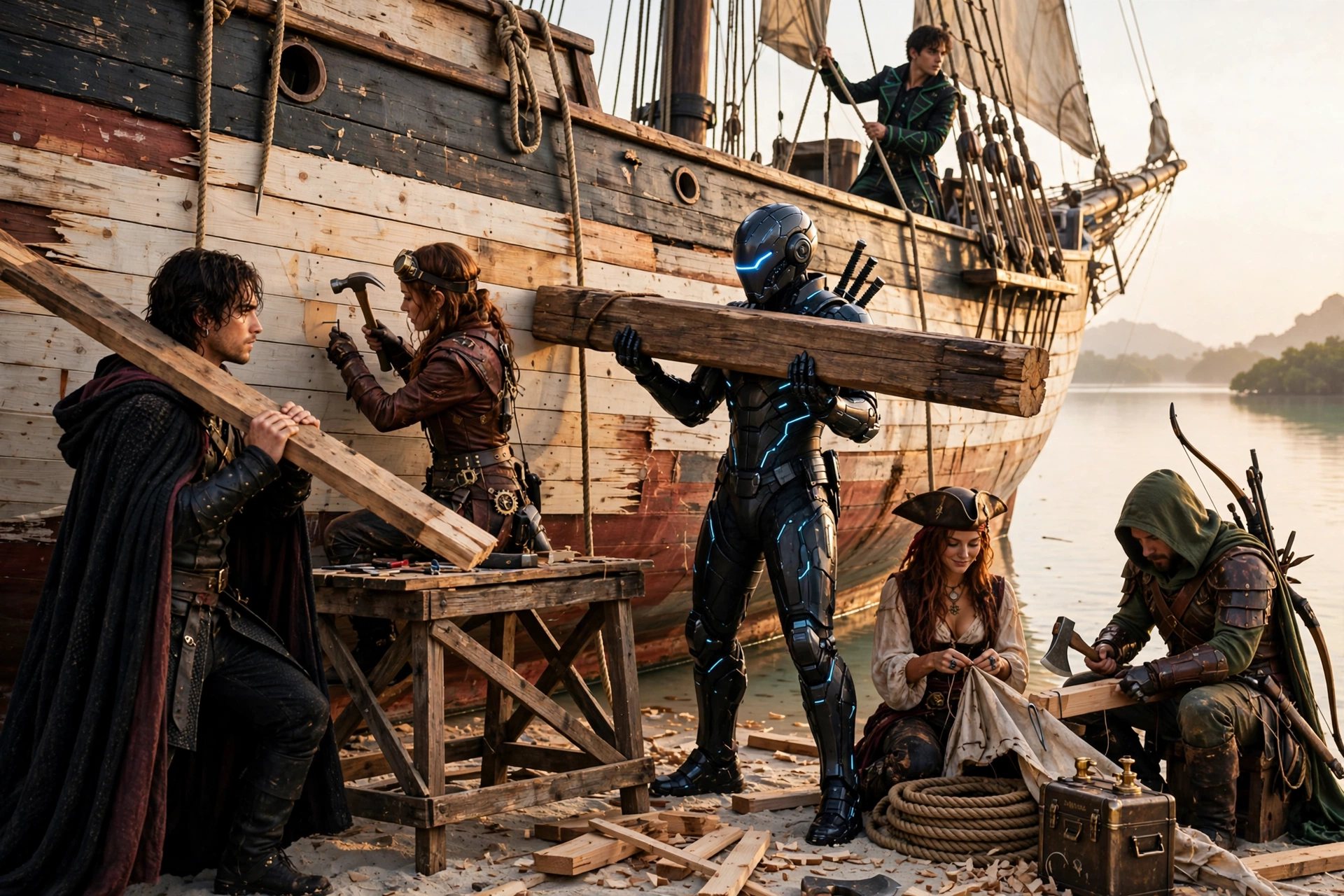
All six of us on the hull: Vesper calling the work, up to her elbows in tar and oakum, directing the patch like a general who happens to be holding a mallet. Volt carrying beams like firewood, whole spars on one shoulder that would have taken three of us and a rope. Rowan shaping spars with the adze, his watcher's hands sure at shipwright's work. Heather stitching sail on the deck, needle flashing, humming something with no words. Kaleb in the rigging, where he claims the view improves him. And me hauling planks, because a captain who won't haul is just a passenger with a title.

"Higher, Kaleb! That seam — no, the other seam! The one that's actually leaking!" Vesper shouted up.

"All seams look innocent from up here," Kaleb called down. "It's a character flaw in seams."

"Less philosophy, more oakum," Heather said, without missing a stitch.

"You heard the co-captain," I said.

"I hear everyone," Kaleb said. "It's the obeying I ration."

Rowan, not looking up from the spar he was shaping, said, "You obeyed fine when the Grandsire looked at you."

"That wasn't obedience. That was taste."

Even Volt, passing with a beam on his shoulder, made a sound that might have been a laugh, filtered through the helm. "Ration increased," he said. "Noted."

We loaded the hoard before we left — all of it. Chests, goblets, the stacked bells, Heather's strongbox and her log laid on top like a keystone. Nothing left at the reef for the sea to keep. The ship would sail low in the water, heavy with a generation of stolen lives, and that was as it should be: the proof was coming home with us.

The lagoon is empty. The deep keeps its own for now — Jonah with his dagger, a beast dreaming below.

Tonight we rest. Tomorrow, the tide takes us out.

Then Tollhaven — and a dead woman's logbook comes home.

Back to contents

Chapter Thirteen — Two Captains

Chapter Thirteen — Two Captains — illustration

The ship floats. Say it again, because we'd stopped believing it: the ship floats, patched and sound, riding at anchor on a calm lagoon with the hold full of treasure and the tide waiting for morning. So that night we did the thing crews do when the work is done and everybody is, against the odds, still alive to do it.

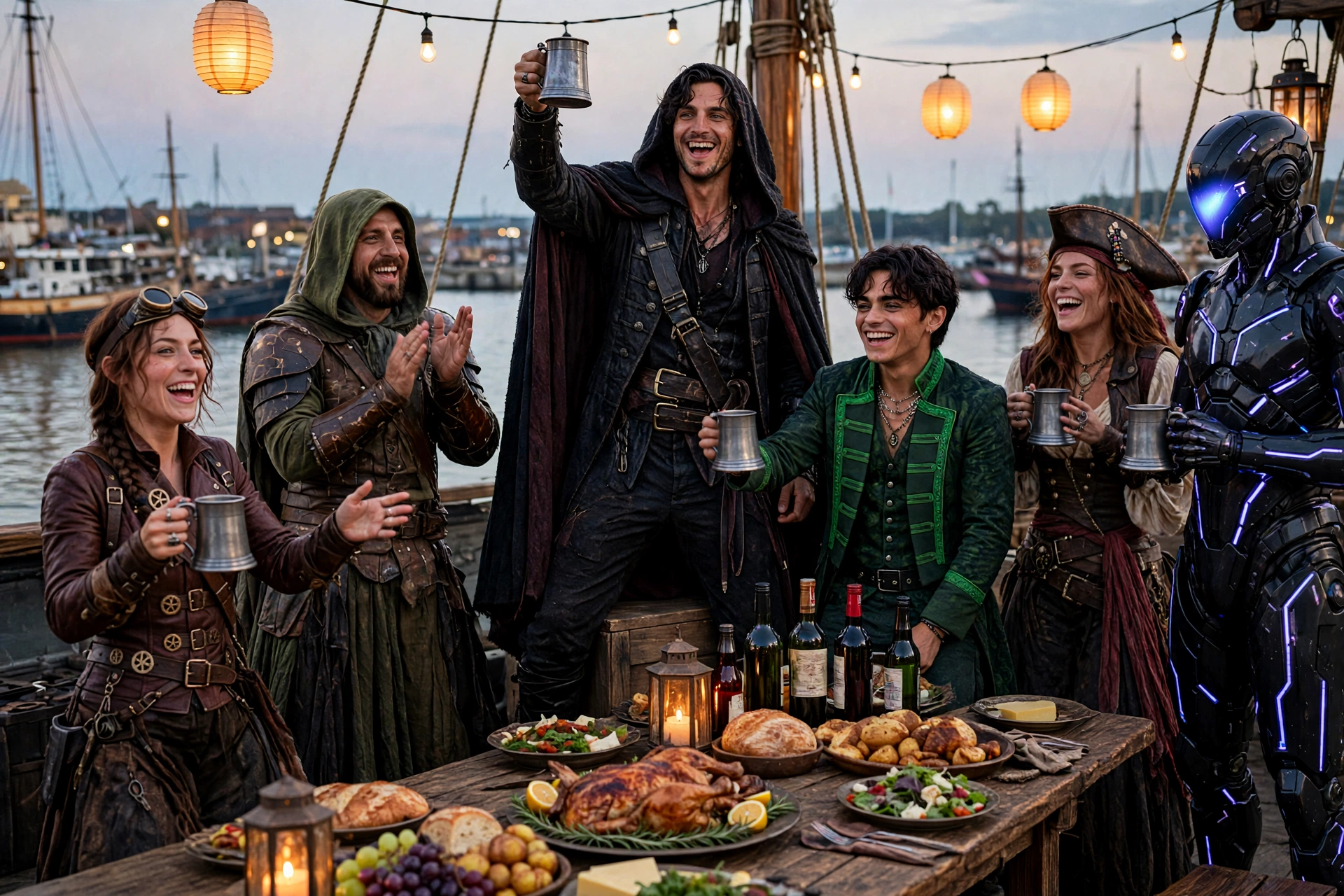
Lanterns up. A roast on the table — salt pork and ship's biscuit dressed up in Vesper's galley sorcery until it nearly believed it was a feast. Mugs full. And dancing, actual dancing, on a deck we almost lost: Kaleb turning Heather in a reel she pretended to resist for exactly four steps, Rowan keeping time with two fingers on the rail and something almost like a smile locked behind his beard, Vesper laughing with her head back, Volt at the edge of the lantern light, watching the way he watches everything, like a man memorising a country he means to live in.

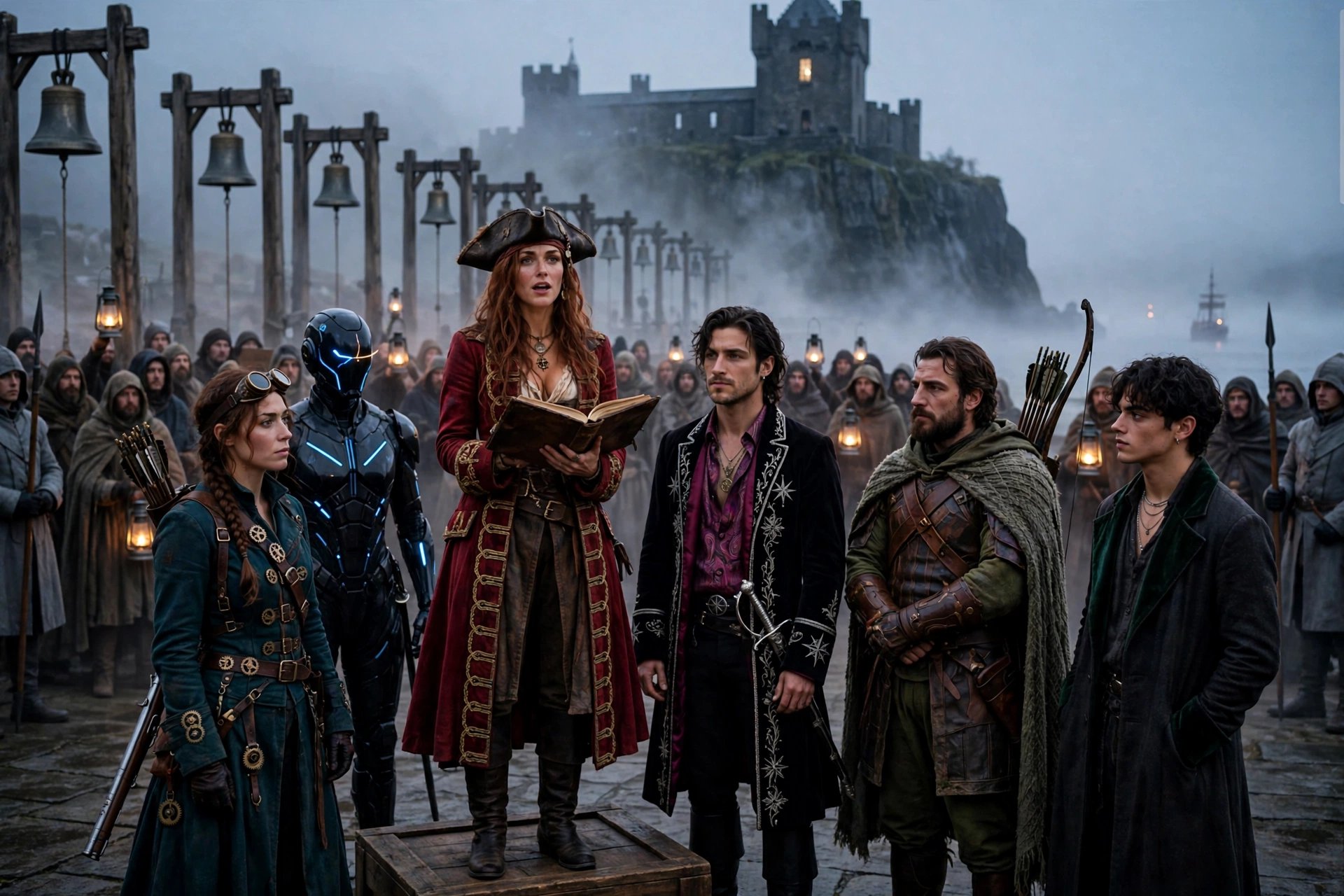
Then I stood on a crate, because some things need a height and a hush, and made it official.

"This ship has two captains now. Heather — co-captain, by my word. And she keeps her hat."

She stood there in her tricorne with her mug in her hand, a captain who'd lost a ship and eleven souls and sailed back into the reef that took them and come out carrying the proof of it. "Two captains," Heather said, "one rule: nobody gets left."

Kaleb's mug was up before she'd finished. "To the captains!"

Vesper near took the lanterns down with hers. "TO THE CAPTAINS!"

Volt held his mug with both hands, careful as a man holding a bird. He is learning. We all are — that was the whole night, really: a crew learning, mug by mug and dance by dance, that it had come through the reef as something more than it went in.

Back to contents

Stormhaven

Part Three

Tollhaven

Chapter One — Loading the Treasure

Chapter One — Loading the Treasure — illustration

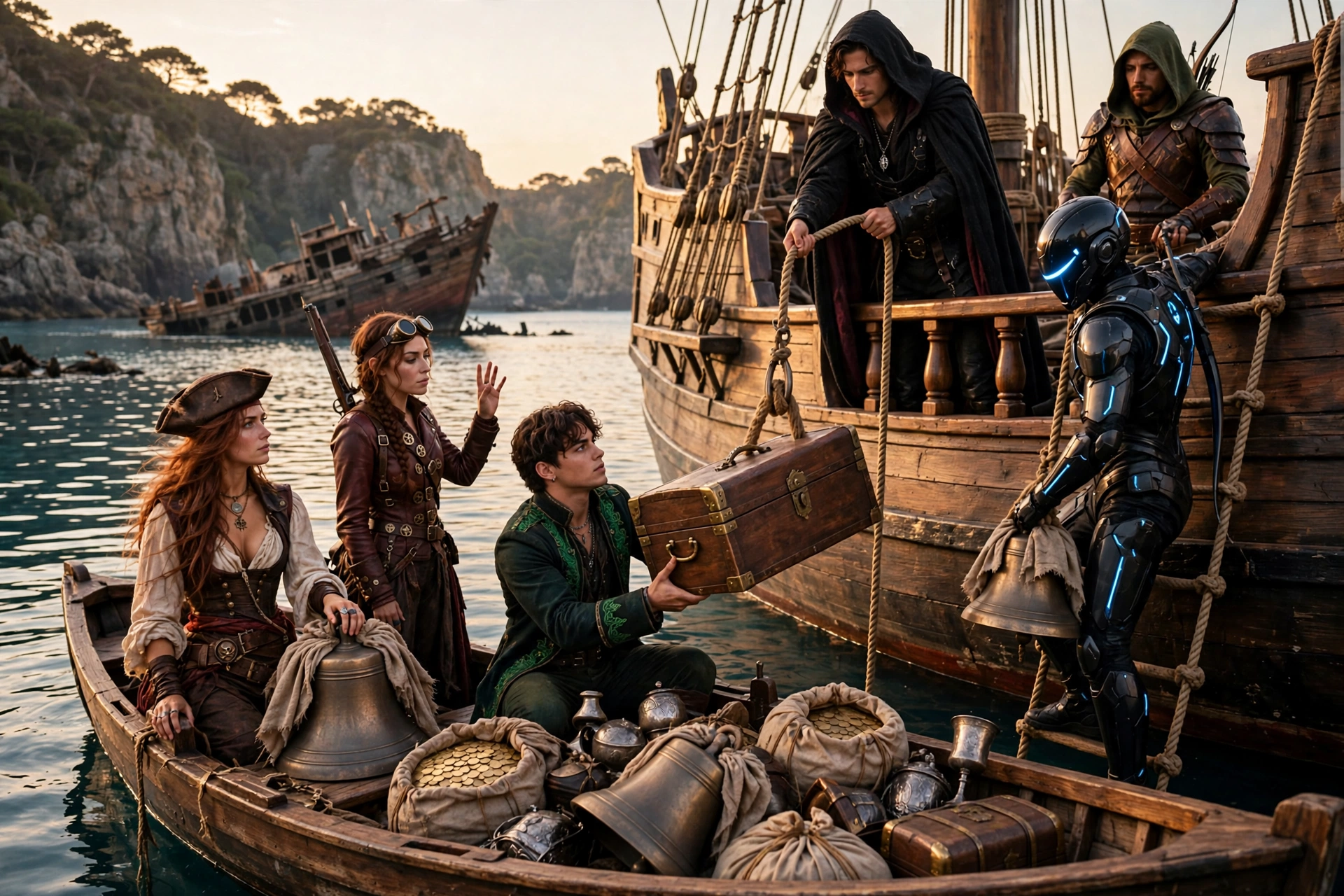
All day, the chaloupe ran between wreck and ship, and I stood at the rail and watched a dead fleet come up out of the water piece by piece.

Chests first, swollen and black with the sea, spilling goblets that rang dully against each other and coin that had gone green as bottle glass. The smell of it came up with every load — rot and brine and old money. Then, last, the bells. Each one came over the side wrapped in sailcloth, muffled, handled the way men handle a coffin through a doorway. Nobody could say why we took such care. Nobody had to.

Vesper counted them up onto the deck the way she counts everything that matters, under her breath, and at the end of it she said it flat, for all of us:

"Ninety-seven bells. He took them as payment."

Heather stood with her tricorn shadowing her face and her hand resting on the nearest wrapped shape, gentle as a hand on a shoulder.

"We carry them as names," she said.

The last one came up in silence. It was Volt who carried it, up the side and over the rail, cradled in both arms the way a man carries a sleeping child, and his visor light was low and steady and he set it down among its brothers without a sound. Ninety-seven. Every ship the Chief had ever tolled down, lying in our hold in sailcloth.

We were still standing there when it happened. Under the hull, far below, down in the green dark where the wreck of Heather's ship lay in pieces — one bell answered. Once. A single note, muffled by all that water, felt in the soles of my boots more than heard.

And at Kaleb's hip, his dagger leaned in its sheath, toward the sound, the way a compass needle leans toward north.

Back to contents

Chapter Two — Through the Teeth

Chapter Two — Through the Teeth — illustration

The Teeth at dawn, and no voice above a whisper. Sound carries on this water, and everything under it is listening.

The light was the colour of wet slate. Heather's hands never left the wheel — a captain at her own ship's helm again, easy as breathing — and Rowan stood at her shoulder and whispered the marks, one by one, the way a man reads a rosary. Port the black rock. Starboard where the water boils over nothing you can see. Slow. Slow.

Wrecks slid past close on either side, masts and ribs and broken hulls in the green below, and every one of them wore its silence like a held breath — their bells still in them, down there, saying nothing.

Then, in our own hold, a bell rang.

Once. Muffled through sailcloth and deck timber, but a bell, unmistakable, in a hold nobody had opened since we'd loaded it.

Vesper's head came up from the rigging. "Nobody's been below."

Kaleb's hand had gone to his dagger without asking him. He looked at me, and his face had the look of a man who has heard a voice in a locked room.

"It answered them," he said.

"Answered who?" Vesper whispered. "We're wrapped. We're muffled. I counted the wrappings myself."

"I know," Kaleb said. "It answered anyway. Maybe it wasn't answering them out there. Maybe it was answering me." His hand tightened on the dagger's hilt, holding it still by force. "It leans toward other bells the way this leans toward — Captain, they're the same language. That's all I'm saying. Same language."

"Then nobody speaks it," Heather said, from the wheel, eyes forward. "Not in this channel. Not until I say."

"Aye," Rowan whispered, at her shoulder. "Next mark: low water over a wreck's ribs. You'll feel her lift. Don't chase it. Let her settle."

"I know my ship," Heather said, softly.

"I know," Rowan said. "I'm telling the channel, not you."

Nobody spoke after that. We rode the last of the channel on our nerves, Heather's knuckles pale on the wheel, until the rocks fell away behind us and the sea opened — grey, wide, honest open sea.

And on my chest, for the first time since I'd owned it, my compass swung forward. Not back toward Stormhaven. Not wandering. Forward, steady, certain as a pointing hand.

Tollhaven.

Back to contents

Chapter Three — The Sail

Chapter Three — The Sail — illustration

Three days, and a heavy ship. She sat low and answered slow, ninety-seven bells riding under our feet, and every man aboard could feel them in the way she rolled — a weight that wasn't cargo so much as company.

Heather ran the watches like a born co-captain, which is what she was, whatever the sea had done to prove otherwise. She set the rotations, walked the deck at the change of the glass, and took the worst of the night hours for herself without making a speech about it. Vesper counted stores instead of shots — canvas, powder, water, biscuit — an engineer's rosary, her pencil moving down the list in the lamplight. Kaleb's dagger leaned aft the whole three days, tugging at his hip toward something behind us, toward Jonah, out there in the deep with the twin of that blade in his dead hand. Kaleb pretended not to notice it. We pretended not to notice him pretending.

On the second night, Heather found me at the stern and spoke low, so the watch wouldn't carry it.

"You've never sailed into a place that owned your archer before," she said.

"No," I said. "Have you?"

"I've sailed into places that owned all of me. It's worse when it's in pieces — a street here, a bell there. He'll see his whole childhood hung on posts and be expected to salute it."
"What do we do for him?"

"We don't make him be our map and our conscience at the same time," she said. "We ask. We don't assume. And when he goes quiet, we don't fill it for him."

Forward, Kaleb was pretending to mend a line he wasn't mending, listening to his dagger lean.

"It's pointing aft again," he said, to no one, then louder, for us: "Jonah, if you're following us, you could at least row."

"He's not following," Vesper said from the stores list. "He's being kept. There's a difference, and it's an ugly one."

"I know the difference," Kaleb said, quieter. "I was trying not to."

Rowan watched the horizon the whole way. That was all he did, and he did it like work. A cliff boy reading the sky for home. And the closer we got, the less he said, until by the last day you could have counted his words on one hand and had fingers left for your supper.

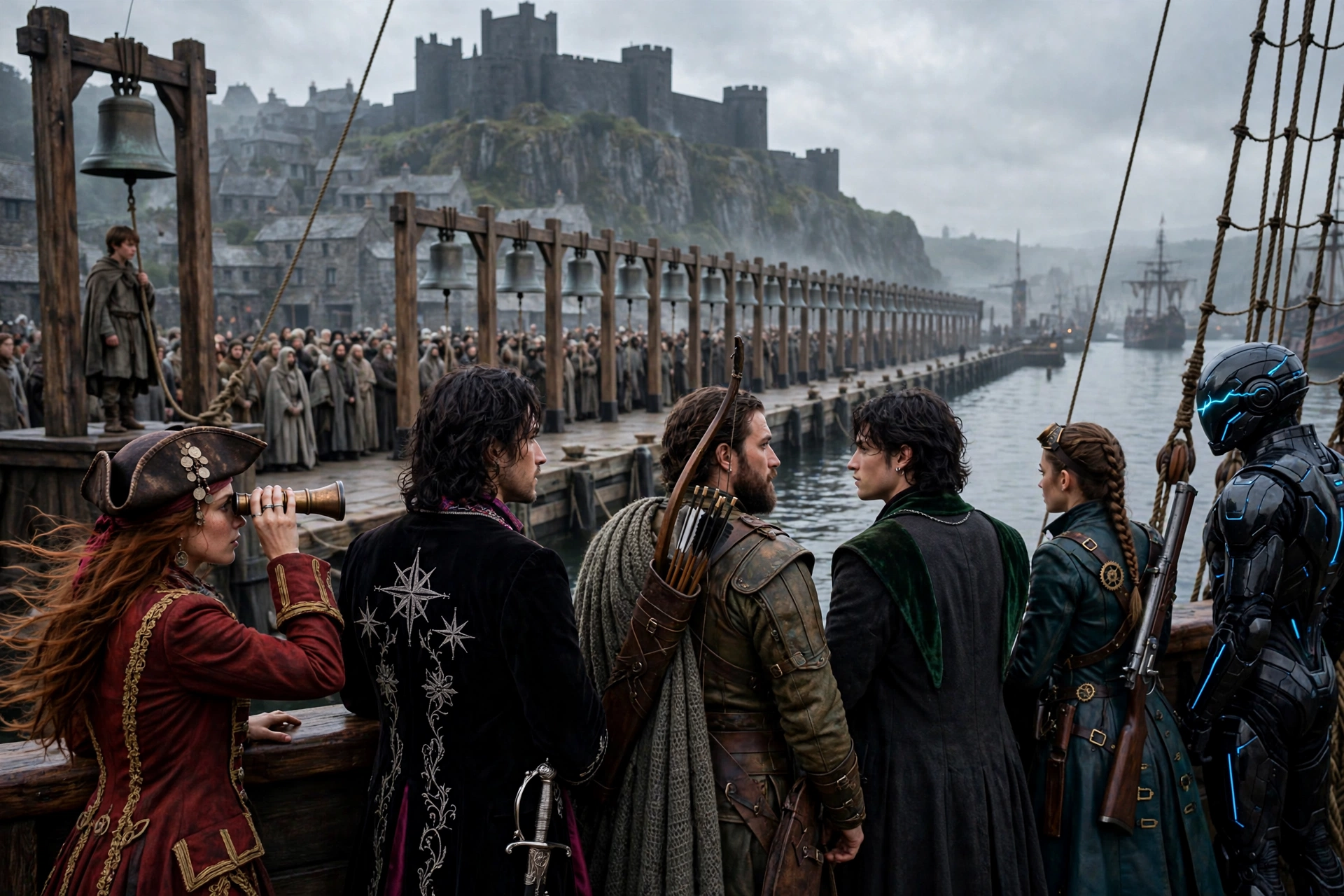
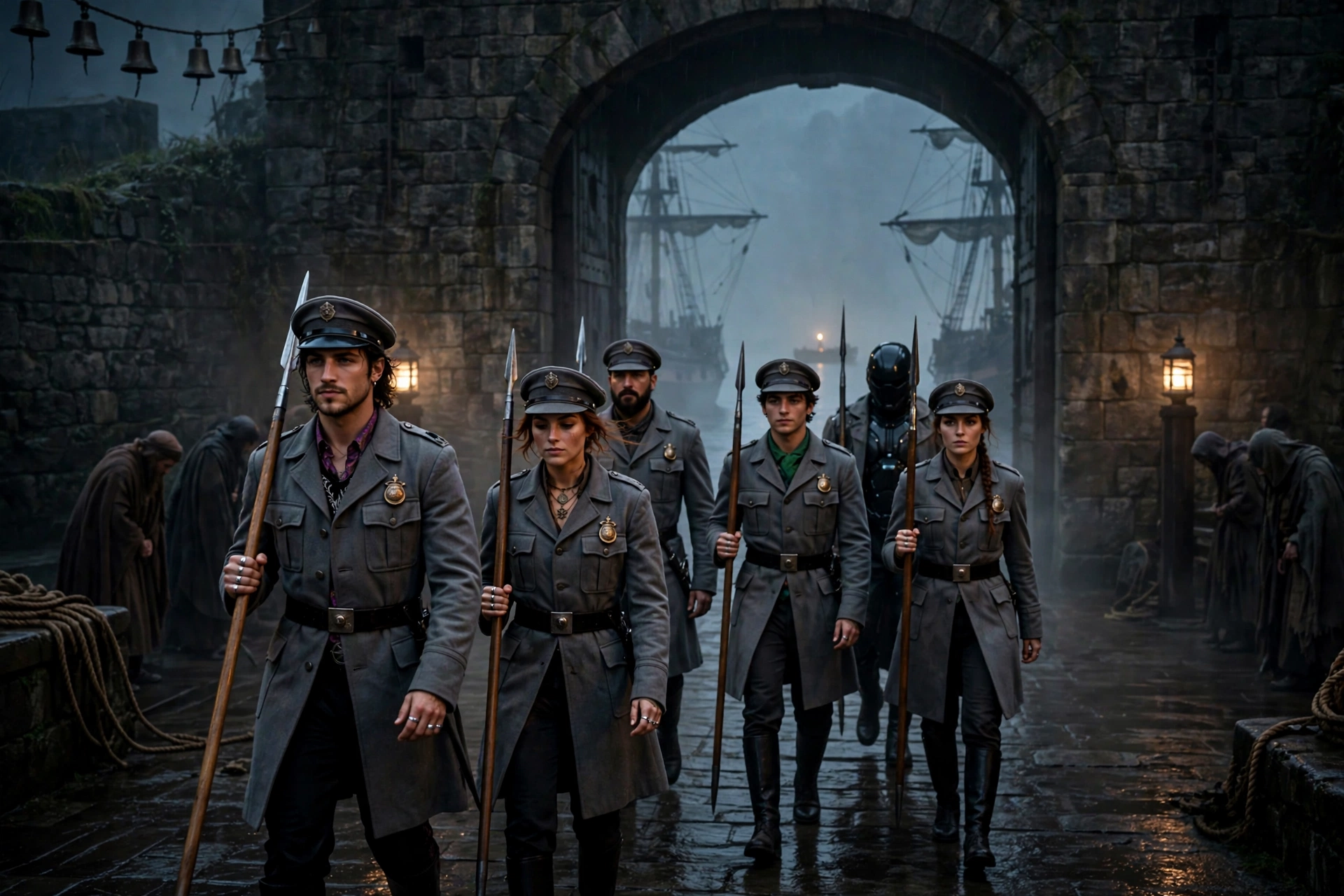
Dusk, third day. Grey cliffs rising out of the sea haze. Village lights coming on one by one along the shore, warm and small. And along the harbour, in the last of the light, a row of tall posts — and on every post, in silhouette, a bell.

Rowan stood beside me at the rail a long time before he spoke.

"Home," he said.

Then, quieter, like a man asking a priest a question he's afraid of:

"Count the bells, Captain. Tell me he's innocent."
Back to contents

Chapter Four — The Arrival

Chapter Four — The Arrival — illustration

We didn't sneak into his harbour. We sailed in heavy at dawn, in full view, low in the water with a dead fleet in our hold, and we let them look.

They came down to the quay the way people come to a fire or a hanging — drawn, and quiet about it. The quay filled in silence. Nobody spoke. Nobody waved. A whole village standing at the water's edge watching a strange ship come home to a harbour that had eaten ships for twenty winters, and not one voice among them.

Heather took my spyglass without asking — she was a captain, it was her right — and she read the bells. Post by post, the way she'd read a muster roll. The Chief's "memorials," the harbour called them. Salvage. Hung like honours along his waterfront, each bell the whole of a ship, crew and all, reduced to one bronze word.

She stopped at the seventh.

I watched her whole body change. A ship's name is cast in her bell's bronze, raised in the metal when the bell is born, and it does not wash off and it does not fade. She lowered the glass. She read hers aloud — her ship's name, her own name under it — for the whole silent quay to hear, and her voice did not shake, and that was worse than shaking.

"That one's mine," Heather said. "He hung my ship in his garden."
Somewhere in the crowd, I swear I heard a man catch his breath. Nobody else made a sound at all.

Back to contents

Chapter Five — Into the City

Chapter Five — Into the City — illustration

Into the city, careful. Vesper stayed with the ship and its hold of names — our anchor and our way out, both, and nobody I'd trust with either over her.

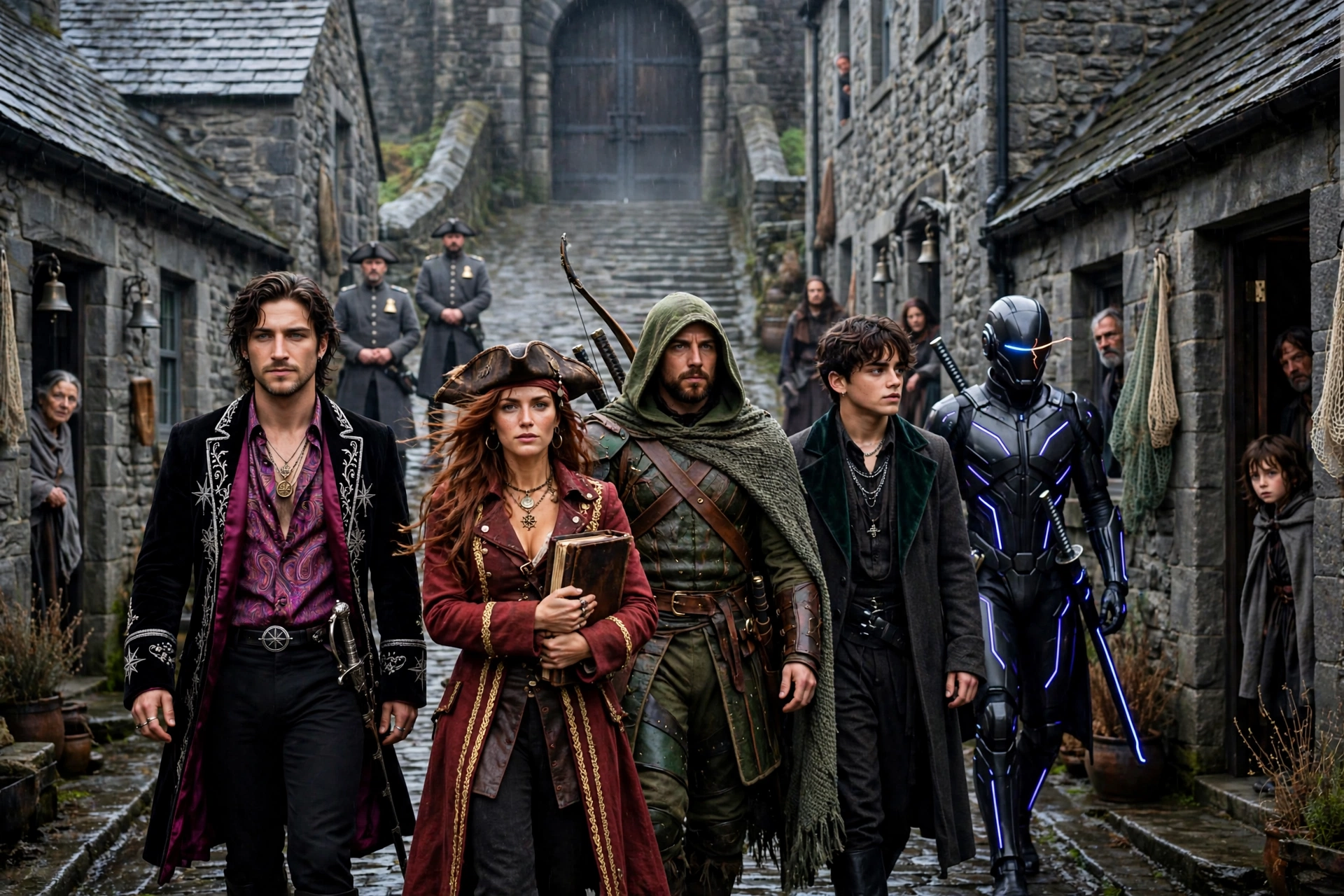
The rest of us went up into Tollhaven, and I understood within ten paces that the bells were not only in the harbour. Every door wears a bell in that village. Little ones, household ones, hung at every lintel we passed — so the dead know their own, the saying goes, so a drowned sailor coming home in the dark can find his door. It is a pretty custom. I have never walked through anything that felt less pretty. Every door watched us pass, and said so, softly, in bronze, whenever the wind moved.

Guards fell in front of us and behind us, grey coats and bell badges, hands kept pointedly off their steel, polite as ushers at a wedding. Escort or cage — who's counting. Kaleb counted.

"Six," he murmured, at my shoulder. "And the ones we can't see aren't guards, they're just shy."

Rowan walked his own streets like a stranger in them. The baker's lane. The steps where the nets were mended. Faces he had grown up among, in doorways and at windows — and nobody called his name. Not one. Whatever he'd been to this village, the village had agreed together to forget it, and the forgetting was in every turned shoulder we passed.

At the top of the Tollkeep steps, their captain was waiting, and he bowed — a real bow, deep and correct — and delivered his master's words like a man who has delivered them to the living before, and enjoyed the novelty less each time.

"The Chief invites the captains to supper tonight. He so rarely has… living guests."

Back to contents

Chapter Six — Supper with the Chief

Chapter Six — Supper with the Chief — illustration

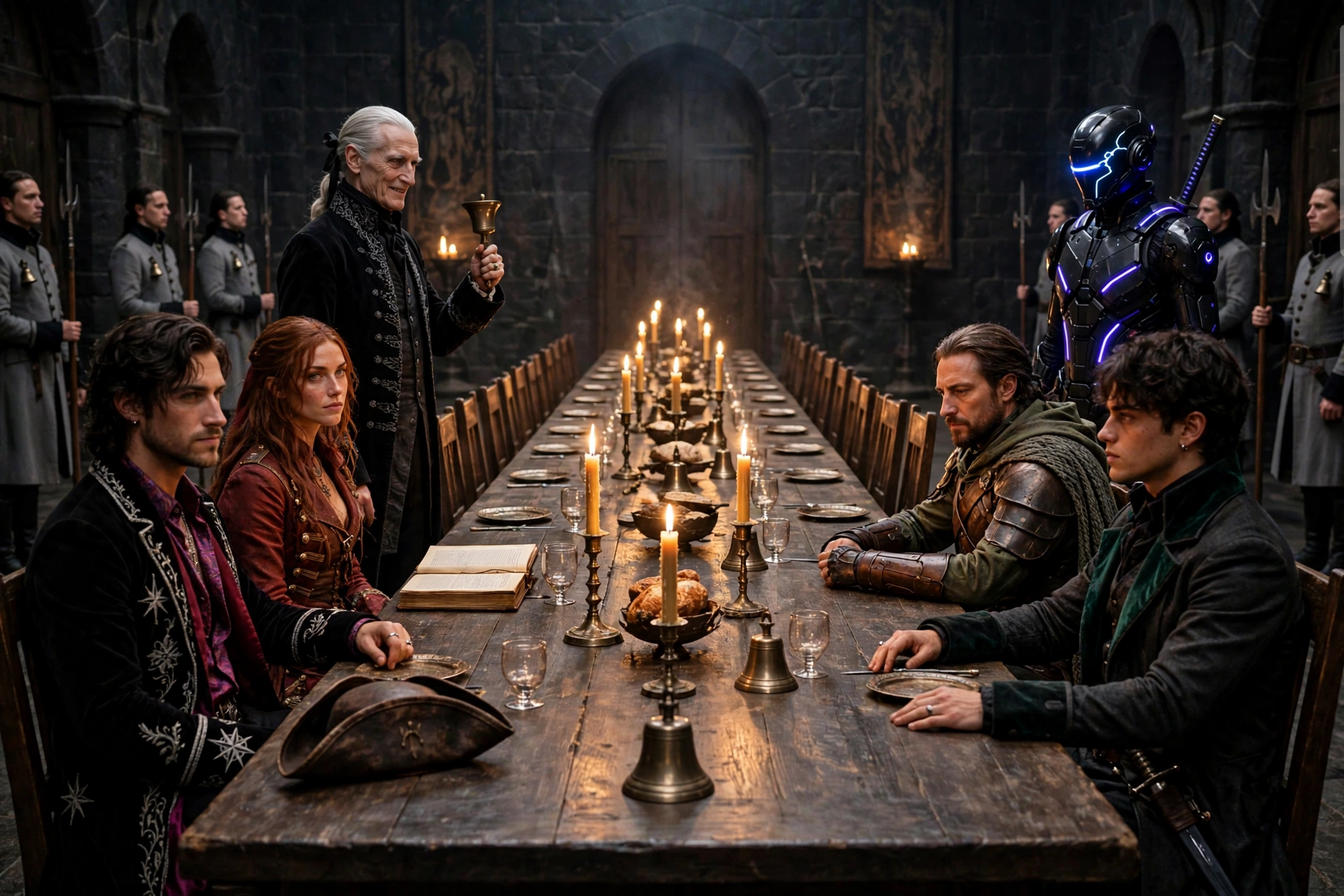
Supper at the Tollkeep, in a hall that had been built for a bigger century. There was a small bell at every place at the table — a bell per place, like a name card — and the Chief poured wine for the empty chairs, one by one, unhurried, the way a man does a thing he has done so often it has become a kind of prayer.

He was not what I had built in my head. Pale as porcelain and too smooth, as if the years had been planed off him; silver hair slicked back; dark eyes set deep, and a smile that arrived at his mouth and never once travelled any further. He knew Rowan the moment we entered, of course.

"My watcher," he said, almost warm. "Come home."

Heather he didn't know at all. He looked at her the way a man looks at a chair that wasn't in the room yesterday — noted her, priced her, moved on. The captain whose ship he had tolled down, whose eleven souls he had harvested — and she was nothing to him. Not a face. Not a name. I felt the temperature of her beside me and put nothing in its way.

He toasted his harvests over the fish course, raising his glass to the empty chairs. "My finest? An October ship. Eleven souls — her bell sings in my garden."

He said it the way a vintner names a good year.

"Tomorrow another comes through the Teeth," he went on. "Eleven more, if the fog holds."

The price came last, with the wine, laid out as simply as the bill. Our hold — emptied into his stores, the bells surrendered as the salvage they legally were — and we might sail on our lives. Or keep them, and the sea collects.

Walking down through the dark afterwards, Heather spoke at last, low, to me alone:

"He toasted my dead."

"He will," I said. "He'll know your face."

Back to contents

Chapter Seven — The Plan

Chapter Seven — The Plan — illustration

They escorted us down through the dark — lanterns before and behind, the little door-bells sighing in the wind off the harbour — and back aboard our own ship, and there, in the cabin, with the lamp low and the hold of bells silent under our feet, we planned.

Heather wanted his head before morning. She said it standing, tricorn still on, cutlass still on, a captain stating a course. Not revenge-talk. Weather-report talk. Give her a dark stair and one minute and the Tollkeep would wake to a succession problem.

I wanted it in daylight. I told her so, and told her why, because she deserved the why and not an order. A sword in the dark makes a murder, and murders get buried. What he'd built couldn't be buried — it had to be seen coming down.

"A bell isn't beaten with swords," I said. "Tomorrow night he tolls for that ship, and the village watches — logbook open."

Read the ledger to them in the garden of bells, at dusk, with the whole village standing in it. Her name, her ship, her eleven, the last page in the Tollkeep's own hand. Let Tollhaven look at its protector with its eyes up, for once.

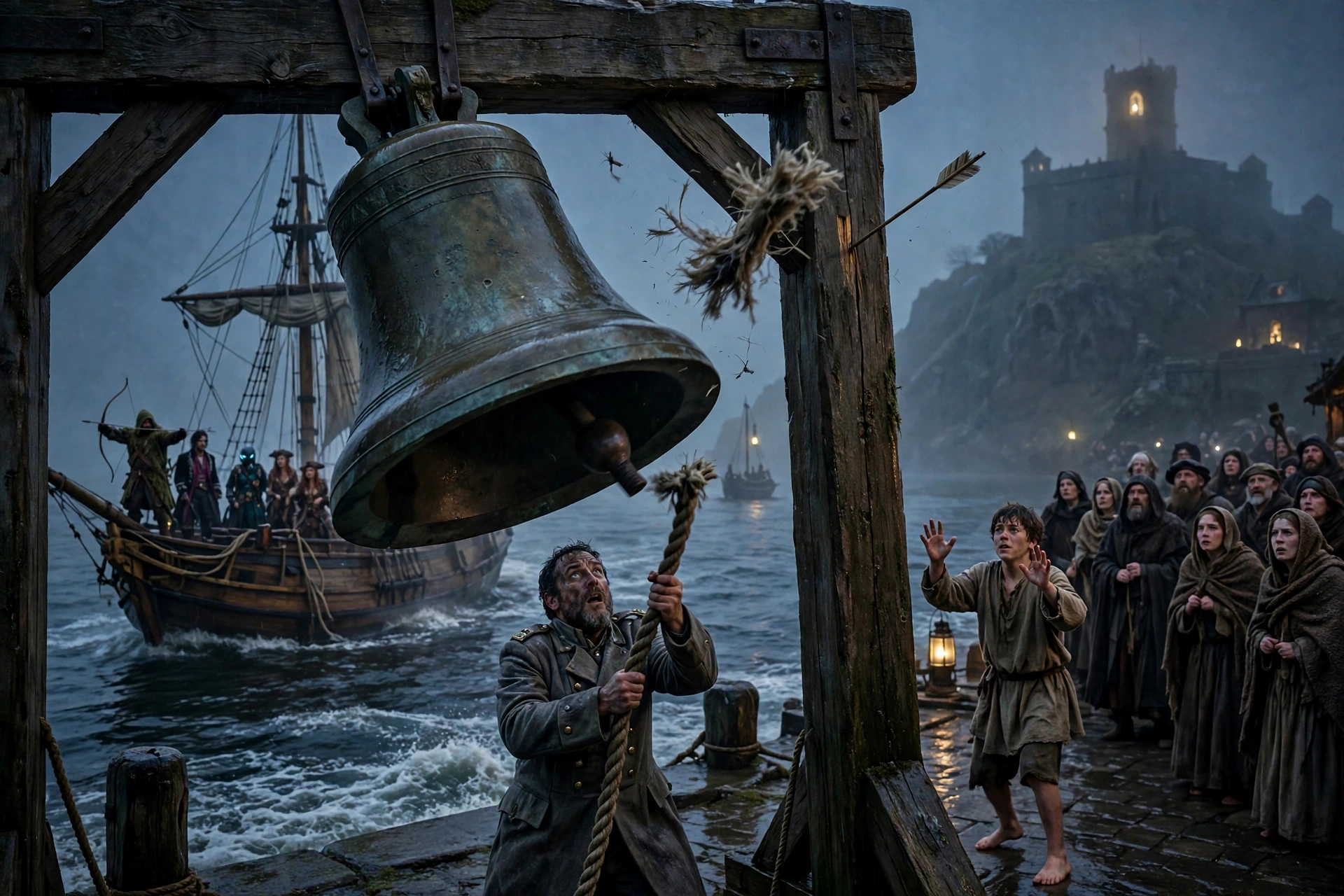
There was one problem, and Rowan named it before I had to. The bell's keeper. The harbour bell — the great bell, the hunting bell — was rung by a boy of fifteen, doing Rowan's old job, believing what Rowan had believed. Whatever we did tomorrow night, it would run through a child standing at a rope.

Rowan stood up. Slowly, the way he did everything that cost him.

"Then he hears it from the one before him," he said.

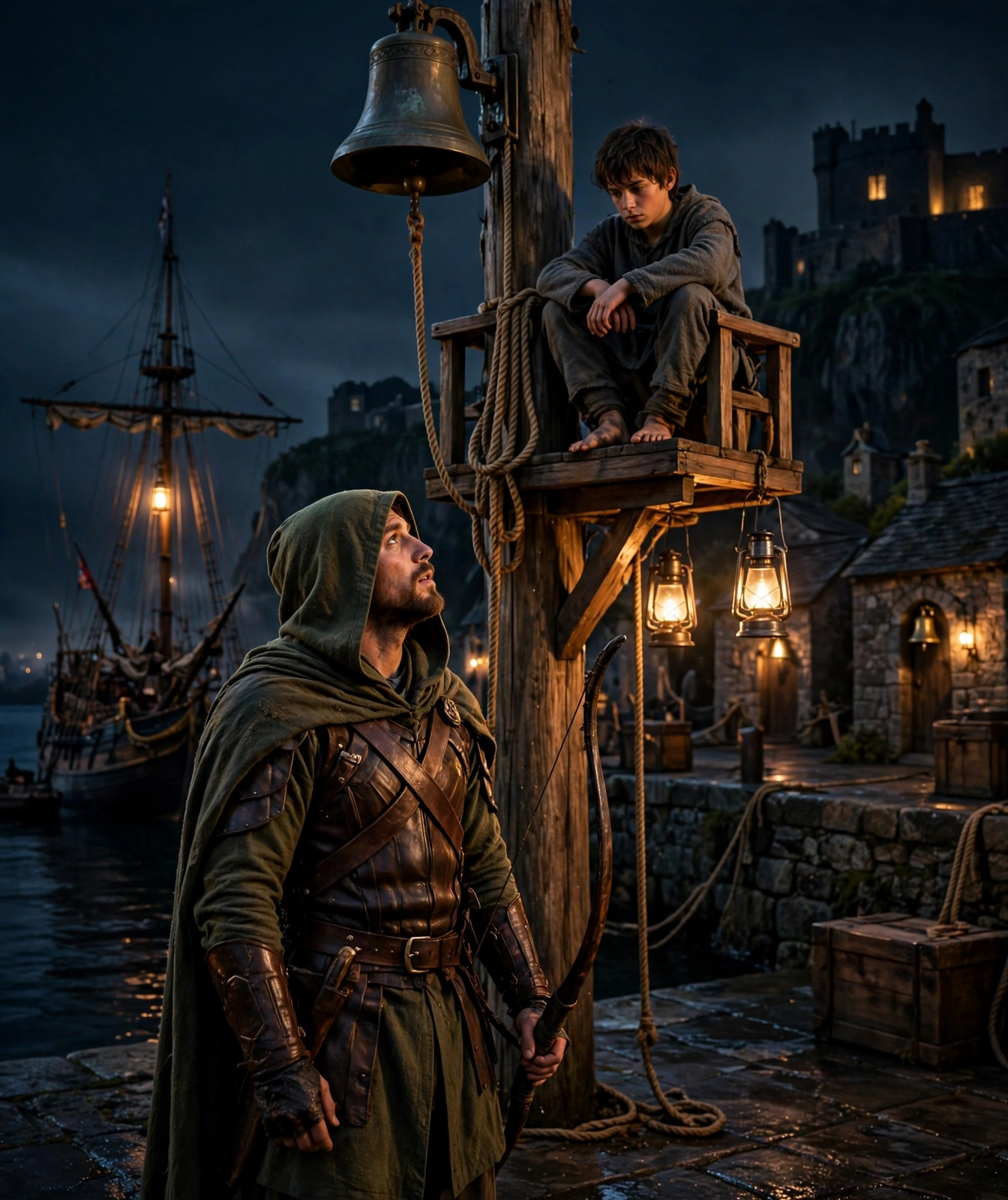
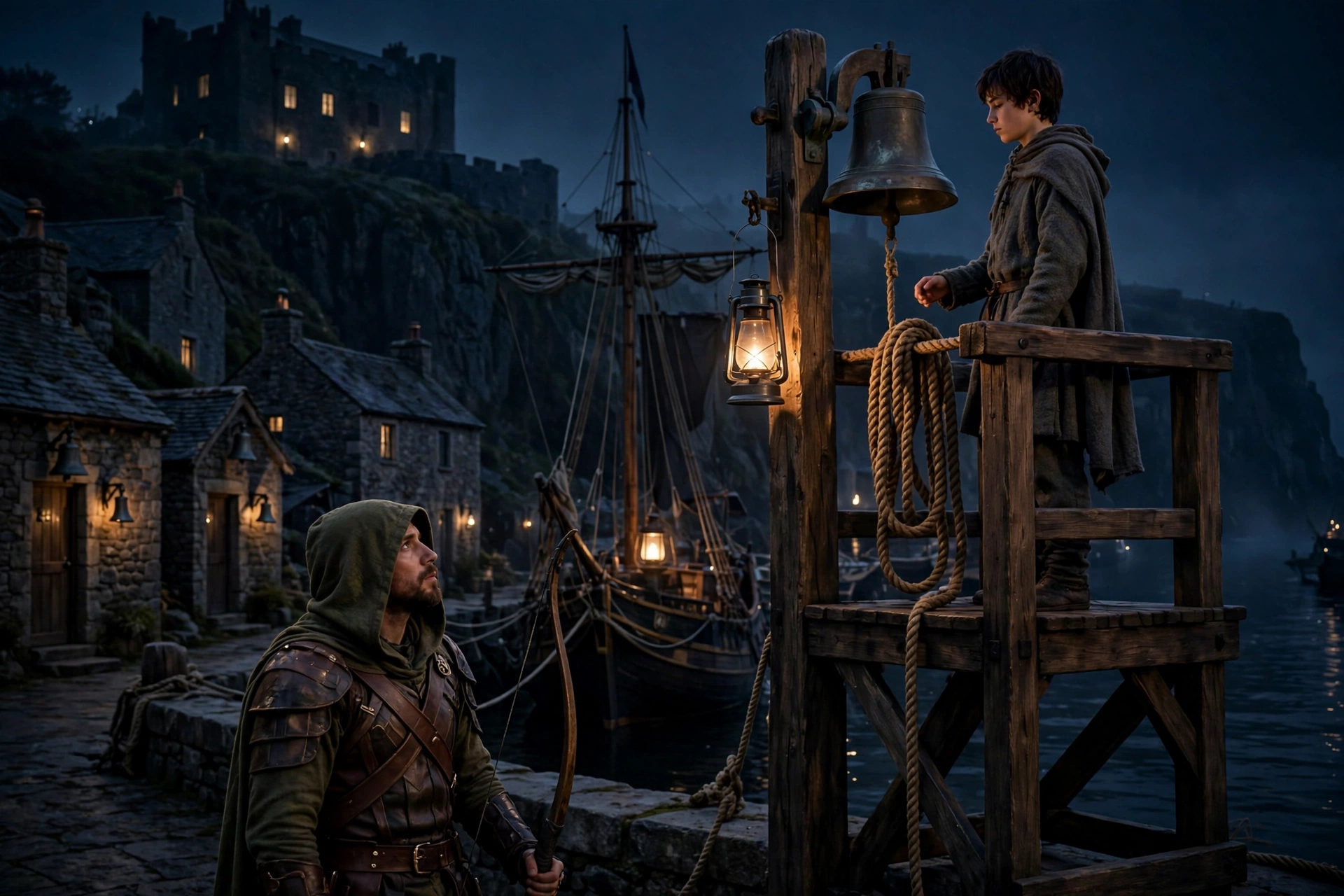
I went up on deck afterwards and found him already gone ashore, alone, standing under the harbour post in the dark with his bow grounded, looking up at a small shape on the platform above him. I heard his voice carry, soft, across the water:

"I know what they tell you it means. I believed it too."

Back to contents

Chapter Eight — The Two Watchers

Chapter Eight — The Two Watchers — illustration

Rowan talked, like confession. I stayed in the shadow of the fish sheds with the others, close enough to hear, far enough that the boy would see only one man come to him — the one before him, not a delegation.

"It doesn't call ships home," Rowan said, up into the dark of the post. "It tells the things under the water where the ship is. That's all it does. That's all it ever did, once he took it. I rang it for years, believing. Years, boy. I stood where you're standing and I pulled that rope with a clean heart, and ships went down on my note like it was a name I was calling them by."

The boy said nothing. The rope creaked a little in the wind off the water.

"Last ship I rang for: eleven souls. Her captain's in your harbour. She came out of the sea — out of the sea, do you understand me — to watch you decide. She's not here for him. She's here to see what the next one does."

Silence above him. Then, small:

"What was it, before?"

"It was a warning bell once," Rowan said. "Before him. It rang to say stay away, rocks, death here — it rang to keep ships alive. He turned it around. Same bell. Same rope. Opposite of itself."

The boy's voice came down thinner. "And if I don't ring?"

"Then they ring it themselves, in front of everyone," Rowan said. "Make them do their own ringing. You've only got the one thing they can't take off you, and it's the pull. Don't give it to them clean."

The boy looked at the water a long time. We left him looking at it.

Back to contents

Chapter Nine — The Reading

Chapter Nine — The Reading — illustration

Dusk. The garden of bells. The village listening.

They came the way they'd come to the quay — drawn, and quiet about it — and they stood among the posts with their hats in their hands while the light went down, and the bells hung over all of us like a congregation that had already heard the sermon a hundred times and come back anyway. Heather stood in the middle of them in her tricorn, with the logbook open in her hands, and read.

Her name, in her own hand, young and certain. Her ship. The set of her crew — her eleven, name by name, each one read out into the garden where their bell hung listening. Then the pages went blank. Water-blank, page after page of nothing, where the sea had taken the ink and the days both. She turned them slowly, so the village could see the nothing. It took a long time. Nobody moved.

And the last page. A page in a careful hand that was not hers. An office hand. A receipt.

"Taken on the third bell. Eleven souls. Salvage to the Tollkeep."

Then she stopped. She closed the book, and when she spoke it wasn't reading any more, and it wasn't quiet, and it was aimed like a gun.

"Not the sea. Not storms. HIM. He aims the Drowned. He feeds the monster. Every bell here, he murdered. I want him dead for all of them."

Nobody answered her. Nobody could. Out beyond the harbour mouth, in the fog coming down the channel — a light, through the Teeth. Tomorrow's ship. Already arriving.

Back to contents

Chapter Ten — The Arrest

Chapter Ten — The Arrest — illustration

Her words hung there in the garden, and the village looked down.

I have seen shame on a crowd before, and I have seen shock, and they are not the same animal. This was not shock. Shock is a face that doesn't know. These were faces that knew. Guilt — twenty winters of it, dropping its eyes all at once in the dusk.

The Chief came down from the Tollkeep himself, unhurried, through the crowd that parted for him without being touched, and he stopped in front of Heather and inclined his head like a host receiving a compliment on the cooking. He thanked her for the sermon.

"All true," he said, pleasantly, into the silence. "And known. Your eleven bought them twenty winters. They pay gladly — don't you?"

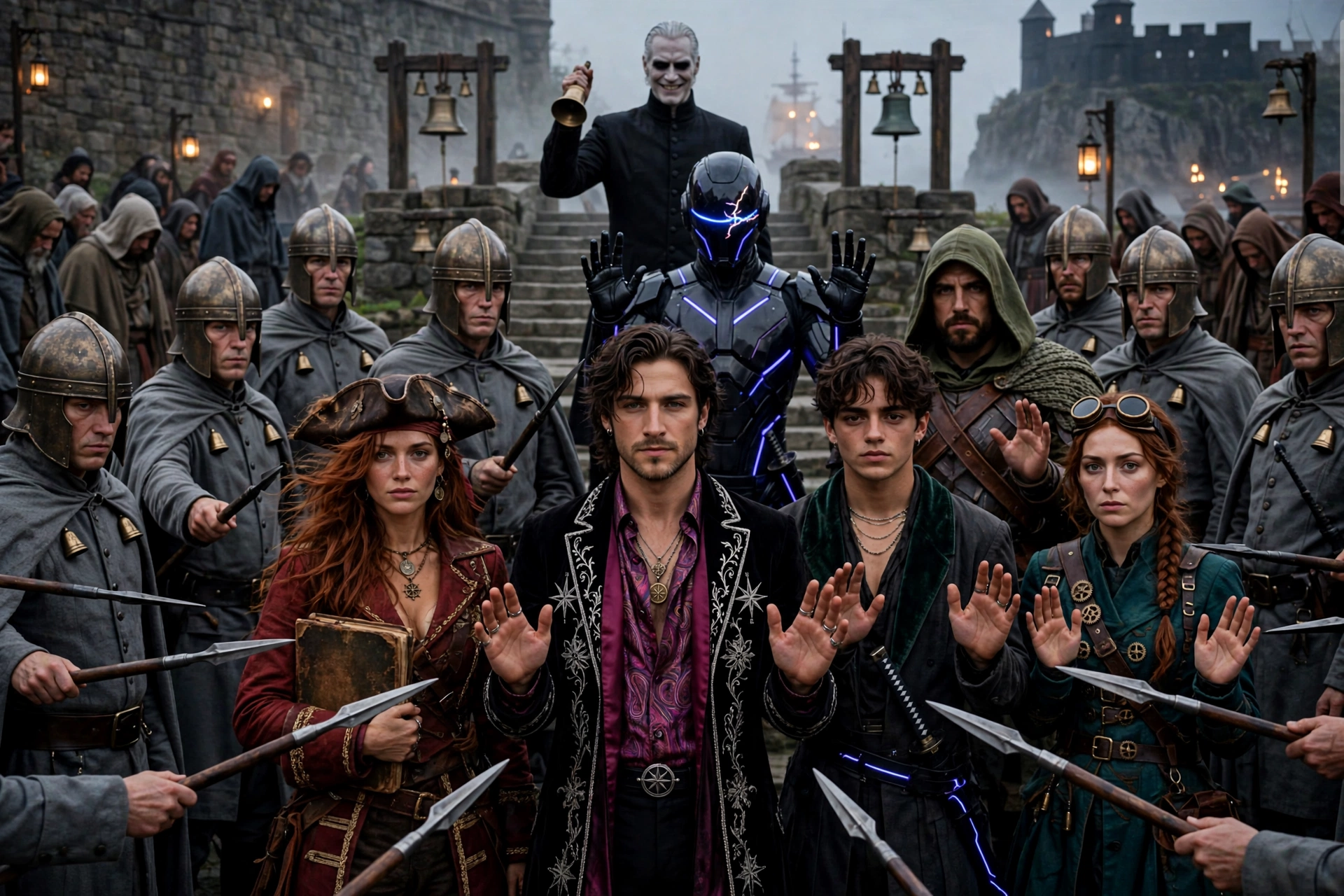
He turned it, gently, to the village, the way a man offers round a dish. Nobody answered. The warrant did. Grey coats were already moving through the crowd, spears grounded, professional, and their captain read it out in a carrying voice: theft of Tollkeep salvage. The bells in our hold. Our whole errand, renamed as a crime.

Kaleb's hand moved at his side — one dagger's worth of answer — and mine stopped it, flat on his wrist, before it finished the journey. Not here. Not on his word, in his garden, with spears at every angle and a village that had just voted with its eyes.

And I saw Volt, standing in the ring of us, blue visor steady in the dusk. Volt, who could have been anywhere else — over the rooftops, gone, beyond any spear ever thrown — in the space of one held breath. He stayed. He stood in the middle of his family and let them put him in a line with the rest of us.

They led us up through the streets to the Tollkeep, six abreast of grey, and below us, out in the harbour dark, the tolling began.

Back to contents

Chapter Eleven — The Cells

Chapter Eleven — The Cells — illustration

They didn't hang us. They kept us — and there's a difference, and the difference is the whole of the man.

Up through the streets in the dark, into the Tollkeep by a side door, down. Down past the kitchens and the wine stores, down to the cellar level where he keeps his harvest. The cells weren't a dungeon built for enemies. They were a store room that had been given bars — inventory space. We were filed.

And the store room itself: bells. Crates stencilled and stacked. Figureheads along one wall with their ships' names planed off the boards beneath them, the shavings long swept away, the carved faces staring out of the lamplight with their identities cut off them like tongues. Everything the sea had been fed, kept tidy. It smelled of brine and old rope and lamp oil, and underneath it all, the specific smell of bronze kept in the dark.

Heather found her own ship's gear two rows in. A coil of her line. Her spare lantern, tagged. A chest with her mark on it, tagged, priced in a clerk's hand. She stood very still in front of it for a long time, in her tricorn, and none of us said anything, because there wasn't a word in any language we had that was the right size.

Kaleb broke it the only way he knows how — gently, by aiming at himself.

"They tagged my spare shirt a price I wouldn't pay for myself," he whispered. "Insulting. Accurate, but insulting."

"Kaleb," Vesper said, very quietly, "not now."

"I know," he said at once. "I know. Sorry. The quiet was getting loud."

Heather reached out and touched the tag on her chest, then let her hand fall. "He kept it tidy," she said. "That's the worst part. Not the taking. The tidiness. As if we were stock."

"We're not stock," Rowan said, from the dark behind us. "Stock doesn't come back to read the labels."

"No," Heather said. "It doesn't." She turned from the chest. "When we get out — and we will get out — I want that page read so loud the garden hears it twice."

"You'll read it," I said. "Nobody else has the right."

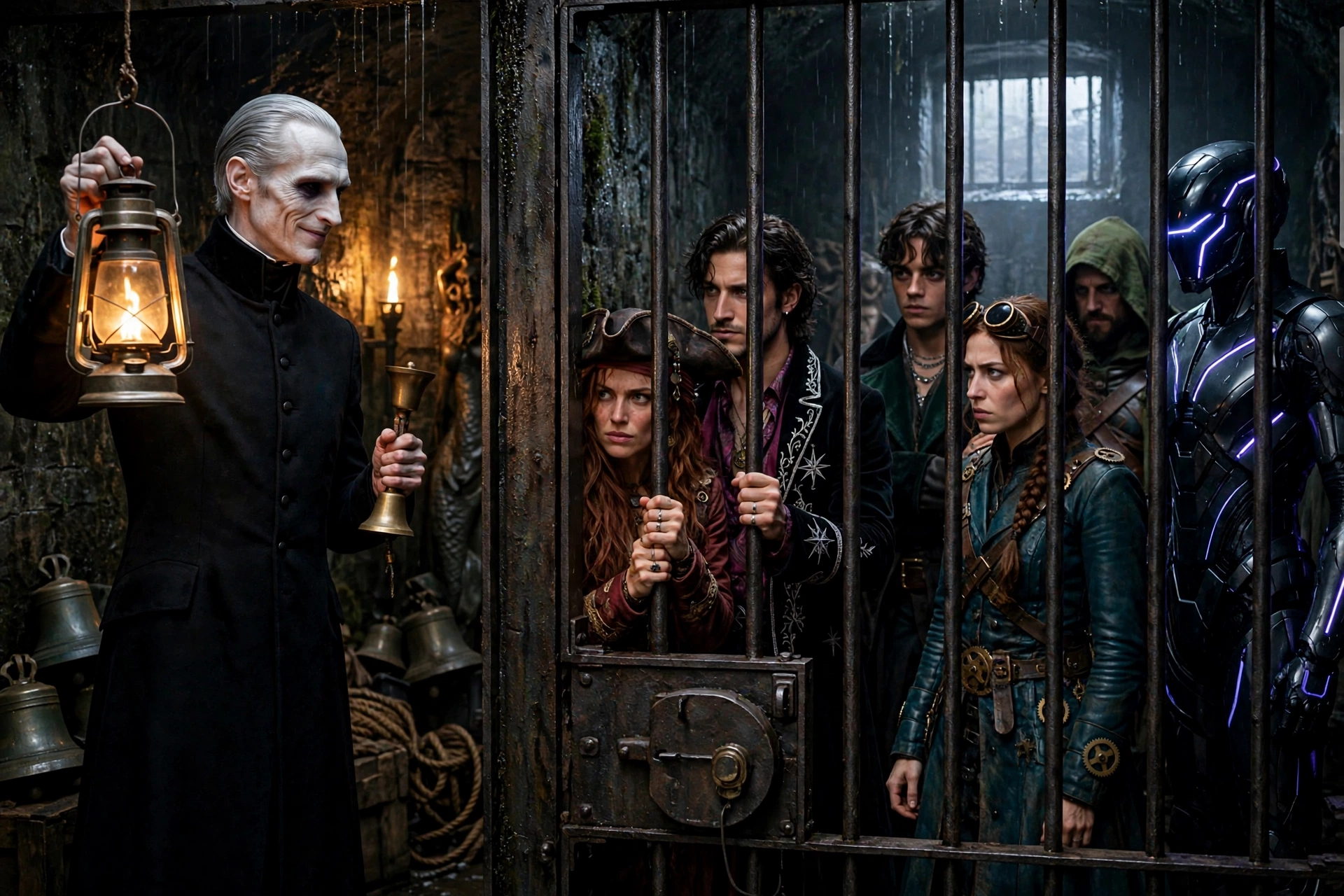
Then lamplight, moving along the corridor. The Chief, outside the bars, with his own lantern and his supper pleasantness still on him like a good coat.

"Eleven winters, Captain," he said to me, almost gently. "Do you know what six more might buy?"

Above us, through stone and timber, chains dragged on stone. Somewhere high in the keep, the great bell was waking.

Back to contents

Chapter Twelve — The Lock

Chapter Twelve — The Lock — illustration

We waited until the Chief's lamplight went round the corner at the top of the stairs, and his steps with it, and the dark settled back over the cellar like water closing over a stone.

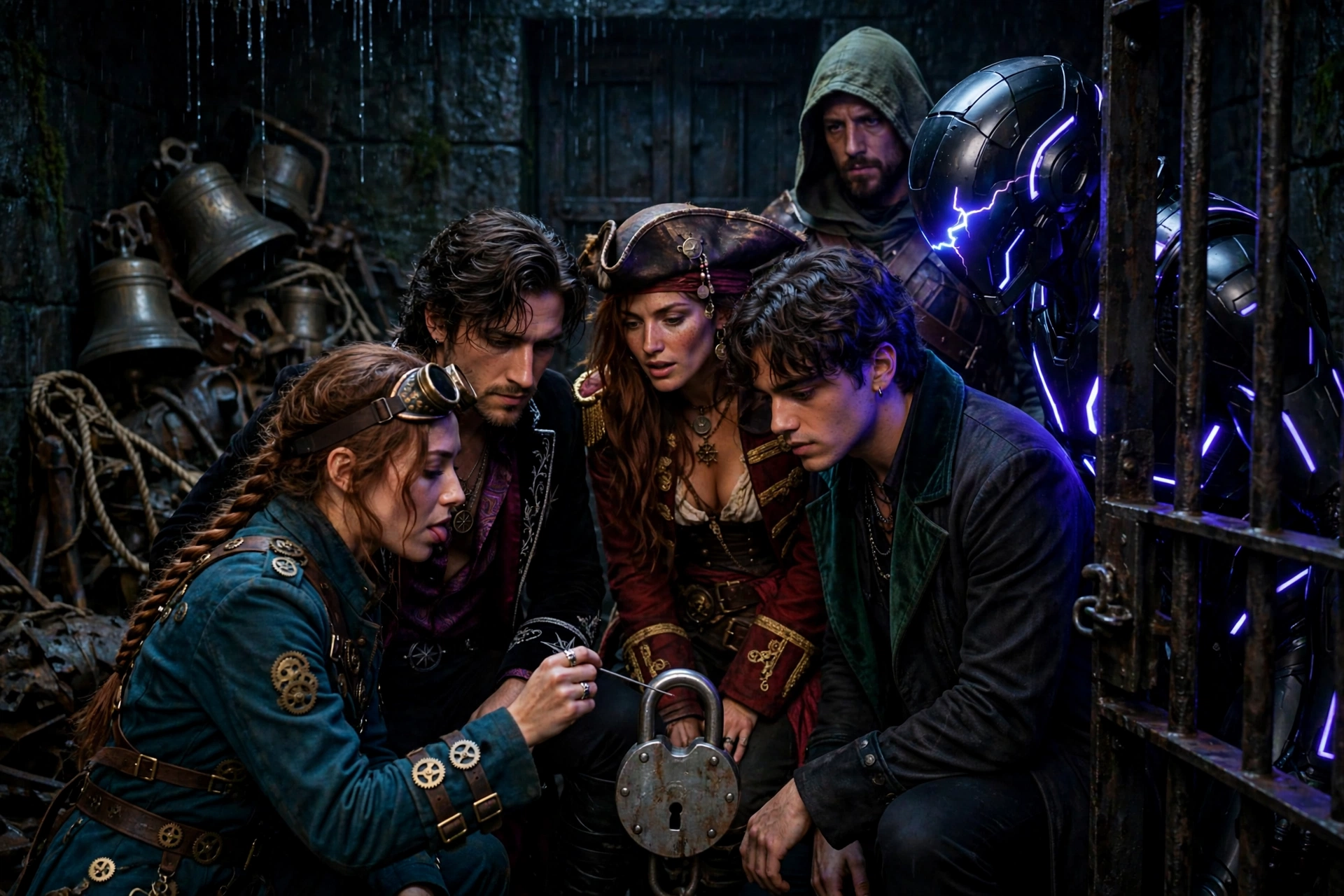
Then Vesper knelt.

She knelt at the cell door the way other people kneel at altars, with her tools already in her hand — a pick, a hook of wire, things she carries the way priests carry beads — and she put her ear to the lock the way a doctor puts his ear to a chest.

"I pick by ear," she said, barely louder than the dark. "One minute of quiet — that's all I need."

Heather had her face to the bars, listening up the corridor, tricorn brim low. "Careful — his guard walks this floor. Lantern, then keys."

That was the rhythm of the place and we all learned it in our bodies: first the light swinging round the far wall, then the keys, then the man. Kaleb had the corridor from his side of the bars, counting under his breath, and his voice came and went like a tide:

"I've got the corridor. Steps — hold — …gone. Go."

The pick moved. Under Vesper's hands the lock was telling her everything it knew, in clicks too small for the rest of us to hear. Volt stood at the back of the cell, dark, patient as furniture, and spoke once, quietly, the way you mention weather:

"If the lock holds, I force the door."

"Last resort, Volt," I said. A forced door is a noise, and a noise is an alarm, and an alarm is the sea. He inclined the visor a fraction. Understood. Filed away.

The lock clicked.

It was the smallest sound in the world. Above us, huge and answering, the great bell of the Tollkeep began to swing — first note rolling down through the stone, for the boat in the fog.

Back to contents

Chapter Thirteen — Out in His Own Colours

Chapter Thirteen — Out in His Own Colours — illustration

Our gear hung tagged two rows over from the cell, in the salvage rows, on hooks, like laundry. Sword, bow, rifle, daggers — and a logbook, sitting on top of the pile of our lives with a clerk's label tied to it in string. Labelled salvage. The Tollkeep had inventoried my crew the way it inventoried a wreck, and I confess my hand shook taking my sword down, though not from fear.

And beside our gear, the spares. Every fortress keeps them: a rack of grey coats in descending sizes, bell badges in a tray like coins, six spears standing in a barrel. The uniform of the men who hadn't stopped us. The uniform of the men we were about to become.

Volt killed his lights. That was the worst of it and the best of it — the visor went dark, the blue seams along his armour died one by one, and we got the biggest of the spare coats onto him, hood up, badge pinned. The biggest guard in Tollhaven, and not one person in that fortress would have believed him for a second at arm's length. At a corridor's length, in the dark, in a line of grey — that was the wager.

Rowan took the head of us, because it was his village and his streets and his shame to spend. "Pairs," he said. "My pace. Nobody talks, nobody looks. Eyes down."

Eyes down was easy. Eyes down was the village's own sacrament on a tolling night; every soul in Tollhaven walked that way between the first note and the last, and six more pairs of boots in step raised nothing at all. Out of his fortress in his colours, our own steel under the grey, walking his own streets past his own door-bells, unchallenged, uncounted, unlooked at.

On the quay, our ship waited dark, exactly where we'd left her in Vesper's keeping — and out in the fog, closer now, a light was moving.

Back to contents

Chapter Fourteen — The Cut Rope

Chapter Fourteen — The Cut Rope — illustration

We were aboard and casting off in the dark, grey coats and all, when it broke.

One of the six "guards" glowed blue under his hood. Volt's seams had crept back to life as his armour woke — a thread of blue light at a collar, a wrist — and a real guard on the quay, a man doing the one job Tollhaven had left him, saw it and understood it in the same breath.

"That's no patrol — that's THEM!"

Shouts went up along the waterfront, house to house, the alarm running ahead of the men who carried it: ring the bell — stop them with the sea. All eyes went to the harbour post, and to the boy on the platform, with his hands at the rope and the whole village watching him do the thing the rope was for.

The boy stepped back.

What Rowan told him held. I saw it from our deck — the small figure, the dropped hands, the step away from the rope, in front of everyone who had ever told him what the rope meant. Fifteen years old, and he un-chose a life in public.

So the captain of the guard did it himself. He rang it before the whole quay — seized the rope and hauled, once, twice, the great voice of the harbour bell rolling out over the water, and down in the channel, in the dark between the Teeth, the water began to answer. You could see it think about rising. You could see the fog itself lean toward the sound.

From our deck, Rowan put an arrow through the rope.

One shot, upward, in bad light, off a moving deck — the arrow he'd been saving since the garden, since supper, since the seventh post. The rope parted high up at the beam. The bell swung once more on its momentum and choked, note strangled in its throat, and the silence that fell down over that harbour was the loudest thing in the world.

The water settled. The lean went out of the fog. And the light in the channel — a stranger's ship, eleven souls who would never know our names — came through the Teeth, safe.

Back to contents

Chapter Fifteen — Dawn

Chapter Fifteen — Dawn — illustration

Dawn found us clear of the Teeth, low and heavy in a grey sea going gold at the edges — ninety-seven bells in the hold under our feet, and one logbook dry at last, wrapped in oilcloth in Heather's keeping, its last page read out loud to the whole of Tollhaven and never to be un-read.

We stripped off the grey as we cleared the headland. Six grey coats went over the side behind us, badges and all, and they floated a while in our wake like a drowned patrol — the Chief's colours, swimming home without him.

Tollhaven watched us go. They lined the harbour wall and the cliff path in the early light, the whole village that had filed past us with its eyes down for two days and twenty winters. Nobody's eyes were down. They watched the ship that had come in heavy go out heavy, and they watched the garden of bells shrink behind us, and some of them — I choose to believe most of them — were doing arithmetic they should have done a long time before we came.

"We didn't take his head," Heather said, at the rail beside me, watching the harbour shrink. She said it like she was testing whether it still angered her.

"No," I said. "We took his story. Heads grow back in places like that. Stories don't."

"They made the boy do it himself," Rowan said, behind us. "The captain, I mean. He rang because the boy wouldn't. Everyone saw the difference."

"Will it hold?" Vesper asked. "When we're over the horizon and he pours wine for empty chairs again?"

"That's theirs now," Heather said. "We carried the proof into the light. Carrying it further is their work. You can't free a village by staying to supervise it."

Kaleb leaned on the rail with his dagger loose in his hand, watching it lean. "Speaking of carrying — mine still wants the deep. Jonah's not done."

"I know," I said.

"Good," Kaleb said. "Because I'm not done either."

Behind us, a harbour and a cut rope that were finally theirs to explain. The Chief still had his keep, and his supper table, and his empty chairs. What he didn't have any more was a village that couldn't say what it knew.

Ahead of us, open water, and the wind freshening, and the whole wide morning. I stood at the rail with Heather's ship's bell quiet in the hold below me and the compass on my chest pointing nowhere it had ever pointed before.

And Kaleb's dagger leaned at his hip, still, toward the deep. Toward Jonah. Whatever we had finished in Tollhaven, the deep had not finished with us.

Back to contents

Stormhaven

Part Four

Gullmarsh

Interlude — THE ARMOUR, PART TWO

Interlude — THE ARMOUR, PART TWO — illustration

We were two days out of Tollhaven, running for Gullmarsh under a sky the colour of wet slate, when Vesper took Volt below into the morning light that came through the hatch and made him kneel. Armour like his does not kneel easily. It went down the way a mast goes down — in sections, complaining. She had her kit spread on a square of sailcloth, her sleeves rolled, her lenses pushed up into her hair, and she worked along the frame of his visor the way another woman might work along a seam she suspected of rotten thread.

That was when she found it. The crack we knew about ran from the brow down toward the cheek, a bright fault in the black. But beside it, finer, half-hidden in the curve of the frame, ran a second line. A sister.

"You said one crack," she said.

"I said the frame is cracked," Volt answered, from inside the helm, in that voice that always sounds like it is coming up out of deep water. "I didn't count."

"I'm counting now." She was quiet a moment, doing sums none of us wanted to hear the end of. "A day of jumps, maybe. Nobody asks him for one."

Kaleb had come down the ladder without any of us hearing him, the way he does. He leaned in the hatchway light with his arms folded and watched Volt kneeling there like a knight at an altar he didn't believe in.

"You could've jumped out of those cells at Tollhaven," he said.

"Yes," Volt said. "I did the arithmetic. I stayed."

Nobody spoke for a breath. We all remembered the cells. We all remembered him standing in the grey coat with his lights killed, one step from anywhere else in the world, choosing the lock-up and the rope's end with the rest of us.

It was Heather who put the point on it. She came down last, tricorn in her hand, hair still wet from the deck watch, and she looked at the cracked visor the way she looks at weather she intends to sail through anyway.

"Hear the new arithmetic," she said. "We fix it. Whatever it costs."

Rowan, at the wheel above us, said nothing at all. But the ship held her course for Gullmarsh, and somehow that was an answer too.

Back to contents

Chapter One — THE FROGS

Chapter One — THE FROGS — illustration

We felt our way into the Gullmarsh anchorage at dusk, the lead going the whole way in. There was no other way to do it. The marsh does not believe in channels the way honest water does; it believes in mud, and reed beds, and soft treacherous banks that take a keel like a hand takes a wrist. So we crept, sail scandalised to a rag, the light going down copper and then grey, while Vesper stood in the bow with the lead line running through her fingers and called the water back to me in a voice pitched to carry no farther than the helm.

"Three fathoms. Two," she called. "Soft bottom — she's got room to swing."

"Room to swing aground, you mean," Kaleb said, from the shrouds, where he had no business being and every intention of staying. "How deep is this marsh?"

"Deep enough, if nobody breathes too loud," Vesper said. "Chain's padded — down she goes."

The anchor went over wrapped in rags, eased down hand over hand so it met the water the way you'd lay a sleeping child into a cot. No splash worth the name. No rattle. We had got good, all of us, at moving through the world quietly, and the marsh at dusk was a place that rewarded it: the air smelled of green water and mud and woodsmoke from some shore fire we could not see, and the frogs — the frogs were a nation. Thousands of them, in the reeds on both banks, a rolling, pulsing, deafening parliament of frogs, so loud it stopped being sound and became a kind of weather.

Then Rowan, at the rail with his head cocked, lifted one hand.

"Quiet, both of you," he said. "Listen—"

And we listened. The marsh had been loud with frogs since sundown.

It wasn't anymore.

The silence came in from the far bank the way a tide goes out — not all at once, but in a widening ring, reed bed by reed bed, until the only sounds left in the world were the water licking our hull and my own heart going in my ears like a fist on a door. Six people on a deck, breathing through their teeth, learning what every small green thing in Gullmarsh already knew.

Something had come into the water with us.

Back to contents

Chapter Two — THE SCOUT

Chapter Two — THE SCOUT — illustration

At noon the next day Rowan took the chaloupe ahead to sound the channel. The ship drew too deep to go in blind, and these were his waters — he had been raised on marshes like this one, in a village of grey stone and greyer obligations, and he could read a reed bed the way Heather reads a chart.

"You sure you want it alone?" I asked him, at the rail, while Vesper checked his lead line knot for the third time.

"Alone is quieter," Rowan said. "Two in a boat is a conversation. The marsh listens for conversations."

"Then don't start one with anything out there," Kaleb said. "Especially if it's bigger than the boat. Especially then."

"I'll try to be boring," Rowan said.

"You excel at it," Heather said, and handed him his water skin herself. "Signal if the channel turns. One splash for soft, two for teeth."

"And if it's neither?" Vesper asked.

Rowan looked out at the reeds. "Then I won't splash at all. And you'll know."

So we watched him go: one man in a small boat, the lead line coiled at his feet, his bow laid across the thwarts like a sleeping dog, pulling away from us into water the colour of strong tea.

The sun stood straight up. There was no shade in the marsh and no mercy in the light; it came off the water in hammered sheets and made the reed beds shimmer. The frogs were loud the whole way in — that rolling daytime chorus, half the volume of the night parliament but steady, a sound you stopped hearing the way you stop hearing your own pulse.

Then the fog came down.

It did not roll in. Marsh fog doesn't roll; it rises, as if the water were exhaling, grey breath off the warm shallows, until the world closes down to an arm's length of reed and a boat-length of brown water. And among the reeds the singing stopped — not fading. Stopping. The way a room stops when a stranger enters it.

Rowan shipped his oars and sat still.

He is good at stillness, our archer. It is the whole of his trade: be the thing the world forgets to notice. He sat in the fog with the lead line slack in his hands and his head up, listening with his whole skin, while the silence widened around him ring by ring, the way it had widened around the ship at dusk.

He never looked behind him. That is the part I cannot get out of my head, telling it now. He never looked behind him.

Because behind him, in the fog, the water stood up in coils — slow, deliberate, barnacle-crusted, rising the way a thought rises, with an amber eye in it that opened and considered the back of his neck — and went down again, soundless, the way it had come.

Back to contents

Chapter Three — THE TALK

Chapter Three — THE TALK — illustration

Back on the ship, fog on the water, the rest of us were doing the work of waiting, which is the hardest work there is. Vesper had the deck — coiling, splicing, mending, her hands never idle, because Vesper's hands are how she thinks. She was halfway along the rail with a serving mallet in her fist when she stopped. Stopped the way a dog stops, mid-step, head up.

She was staring at Volt.

He stood where he always stands in fog, a little apart, facing outward, the blue of him banked low. And as she watched, the light in his visor stuttered. Not dimmed. Stuttered — a catch, a hitch, a missed beat in the one rhythm aboard that ship none of us had ever heard miss.

"Your light stuttered," she said.

"It does that now," Volt said. "Since the Grandsire."

Heather came out of the companionway with her coat half on and her tricorn in her hand, and whatever she had been about to say died when she saw Vesper's face. She looked at Volt, and at the visor, and she did what she always does when she is frightened: she got plain.

"Explain it," she said. "Plainly."

So he did. Standing in the fog with the water slapping soft against the hull and Rowan somewhere out in the grey in a boat too small for what was in the marsh with him, Volt told us the thing he had been carrying alone since the lagoon.

"The suit makes my air," he said. "Yours is not enough for me. The crack spends it — a cup a day. A jump, a day more."

A cup a day. I did the arithmetic the way he'd done it in the cells, and I did not enjoy where it ended.

"Then no more jumps," Kaleb said.

"No more jumps," Volt said.

Six of us aboard. One of us breathing borrowed air.

Back to contents

Chapter Four — THE CHAIN

Chapter Four — THE CHAIN — illustration

Rowan poled for the shallows and threw the lead. He had worked it out alone in the fog, with nothing but the silence for counsel, and the plan he made was a good one — the oldest one the marsh itself teaches. Everything big in that water needed depth to swim in. The shallows, where the mud rose and the reeds stood in brown ranks, were a road too thin for anything larger than a boat. So he poled for them, standing in the stern sheets with the pole bending under him, driving the chaloupe toward the reed wall hand over hand, quiet as a heron.

On the ship we heard the lead strike. He'd thrown it wide — a splash, a false note, a decoy thrown out to whatever listened in that water, to draw its attention off the small boat and the man in it.

It followed him anyway.

We saw it before he did. That is the God's truth and the shame of it: we stood at our own rail, five of us, with the whole fog thinning off the water in rags, and we watched it stand in the mist at his back while he climbed. He had got the chaloupe to the chain and gone up it the way he'd gone up a hundred harbour chains in his life, hand over hand, silent, his whole mind on the next link — and behind him, at the chain, wearing the fog like a cloak it was shedding, it stood. He never saw it. We did.

"What is that thing?" — out of me before I could stop it, and I am not a man who loses hold of his own voice often.

"It's right behind him," Kaleb said, at my shoulder, gone white to the lips. "It's right—"

"Don't shout," Heather said, through her teeth, her hand clamped on Kaleb's arm like a vice. "Nobody shout."

"It can't be that big," Vesper said. "Tell me it can't be that big."

Nobody told her. Rowan came over the rail the way a man comes out of deep water, and we hauled the last of him inboard and cut the chaloupe loose to drift, and stood there all of us breathing like runners who have come a long way uphill and cannot yet afford to stop.

On deck he spent three words.

"Channel's taken," Rowan said.

Back to contents

Chapter Five — THE HEAD

Chapter Five — THE HEAD — illustration

We wrapped everything we could. That was the rule we had made for ourselves coming out of Tollhaven, and we kept it the way sailors keep any rule that has ever saved them: without being told twice. Sails furled and lashed in canvas. Loose gear struck below or wedged and muffled. Boots off; we went in stocking feet on our own deck, six grown people padding about like thieves in our own house, and every order passed mouth to ear, hand to shoulder, in a whisper.

It didn't matter.

A ship can't hold her breath. That is the thing nobody tells you about a wooden ship until you need her silent: she is a living, talking creature, and she will not stop. The hull groaned against the water with every shift of her weight. The mast talked in its step, a long wooden mutter. The water slapped her planks in a slow, irregular rhythm that no padding in the world could still. She announced us down the channel, our good ship, loudly as a crier in a market square, and there was not one thing any of us could do about it except stand at the rail in our stockings and listen to her do it.

Then the fog opened.

It did not lift. It opened, the way an eye opens — a seam in the grey, widening — and on the other side of it, close enough that I could smell the marsh off it, rank and green and ancient, the head came up.

Bigger than the chaloupe. I had known that, in the way you know a thing someone has told you. Knowing is not seeing. It rose out of the water on a neck like a tree trunk that had learned to bend, barnacles crusted white and grey along the ridges of it, old scars shining through the wet hide like seams in a coat. And the eyes. The things in the deep that we had fought before were blind, all of them, hunters by sound alone, and we had built our whole survival on their blindness.

These eyes were open. Reading us one by one, like a list.

"Nobody move," I breathed. "Nobody give it a reason to finish deciding."

"I'm not moving," Kaleb whispered. "I'm barely even a person right now. I'm furniture. Marsh furniture."

"Kaleb," Vesper whispered. "Furniture doesn't talk."

"Sorry. Rustling. That was rustling."

"It's looking at us," Kaleb said, a moment later, all the joke gone out of him.

"It sees," Volt said.

"The blind ones hunted sound," Rowan whispered from the bow. "This one hunts everything. Don't be loud. Don't be bright. Don't be interesting."

"Too late for Volt, then," Kaleb whispered, and Heather's hand found the back of his coat and held it, the way you hold a man who jokes because the alternative is shaking.

"Then why isn't it—" Heather began.

She never finished. Because it wasn't hunting anymore.

It was deciding.

Back to contents

Chapter Six — THE STRIKE

Chapter Six — THE STRIKE — illustration

The chaloupe bumped the hull. Once. Just once.

We had cut it loose when Rowan came up the chain, and the marsh had kept it the way the marsh keeps everything — close, and quiet, and patient — and now the current brought it home against our side with one soft wooden knock, no louder than a knuckle on a door. In any other water, on any other day, none of us would have heard it at all.

The head reared back. The hiss came out of it like steam — like the marsh tearing, a sound that went through the teeth and the breastbone and out the other side, and every frog for a mile that still had a voice left spent it in the same instant.

Then it struck.

Kaleb was already over the rail. I have thought about that since — about the half-second when a quieter man would have waited for an order, a plan, a word from me, and Kaleb spent it in the air. Onto the head. He landed the way he lands off rooftops, all balance and insult, and drove one dagger between the scales of its skull with both hands and his whole weight behind it. The head shook — a vast, appalled shake, water flying off it in sheets — and he stayed. Grinning. Of course he was grinning.

Volt went after him — on his feet, not his light. No jump, no vanished air, nothing spent that he could not afford: he ran the neck the way a man runs a capsizing yard, katana carving blue, the blade leaving its light hanging in the fog behind him like writing.

"Kaleb, off its head!" I shouted. "That's not a horse!"

"Everything's a horse if you're committed!" he shouted back, driving the dagger in again. "Bad horse! Very bad horse!"

"Volt, the neck — find a seam!" Heather yelled.

"Looking," Volt said, already moving. "Scales overlap. There will be a weak fold."

"Rowan, eyes! Keep it busy!"

"Working on it," Rowan called, loosing, drawing, loosing again. "It blinks slower than it strikes. Remember that."

"I'd rather it blinked never and struck never!" Vesper said, and fired again. "One! That's for making me count in a swamp!"

Vesper's rifle cracked. Rowan's bow sang under it. And Heather and I met the neck at the rail where it came down across our deck like a falling tower, and we put our steel into it together — steel on scale, and the scales won. My cutlass rang and skated and threw a spark, and I might as well have struck the side of a mountain for all the good it did, and beside me Heather was swearing in a language I did not know she knew, and striking, and striking, and the scales won.

"It's not working!" I shouted.

"I noticed!" Heather shouted back. "Keep striking anyway — it's noticing us, and noticing us means it's not noticing him!" She meant Kaleb, still up there, holding on.

Back to contents

Chapter Seven — BETWEEN

Chapter Seven — BETWEEN — illustration

The head whipped. Kaleb went off it like a stone.

There was no art to it and no warning — one moment he was on the skull with his dagger in to the crossguard and the next the whole head snapped sideways with the speed of a thing ten times smaller, and he was simply gone, flung out over the water in a tumble of coat and limbs, and the marsh took him with a splash that sounded, in that ringing silence after the hiss, obscenely small.

He hit the water and came up wrong — blood in his hair. He got one arm up and his face out of the water and that was all; the rest of him was hanging crooked, hurt somewhere we couldn't see, and the current had hold of him, and the head was already turning.

Volt was still on the neck. His blade skated — that same mountain-ring, that same useless spark — and then, where the neck bent, where the great plates of the thing's armour had to open against each other to let it move at all, the blade sank. To the hilt. I saw the light of it go down into the seam like a coal into snow.

"Between!" Volt shouted, and his voice off the helm was the loudest thing in the world. "Between the scales!"

We stopped hacking and started prying. That is the difference, in the end, between a fight and a butchery: we had been striking the armour, and now we worked the hinges. Heather's cutlass went in like a key into the seam where the neck bends, and she hung her whole weight on it and levered, and mine followed hers, blade flat, prying the plates apart seam by seam while Rowan put arrows into the opened flesh as fast as a man can draw and Vesper fired and reloaded and fired with the smoke hanging round her head like a grey halo.

It dove with Volt on it. The whole vast body rolled and went down in a boiling of mud and foam and he was gone with it, down into that brown water — and then he cut free and hit the deck rolling, streaming marsh, his light guttering but lit, and the water closed black over a wounded thing.

Kaleb, through the blood: "Worth it."

Back to contents

Chapter Eight — IN HALF

Chapter Eight — IN HALF — illustration

The head whipped. Kaleb went off it like a stone.

He hit the water and came up wrong — blood in his hair. He got a hand up, and then not even that; he was hanging in the current at the angle of a man whose body has stopped taking his orders, and the blood was coming off him in the water in a slow red thread, and the wounded head — the head we had opened, seam by seam — was swinging round toward the smell of it.

We were fighting, steel in the seam, when we saw him down there bleeding.

Heather dropped her cutlass first. I want that set down plain, because she would never set it down herself: in the middle of the fight of our lives, with the seam open in front of her and her blade doing the only work any of ours had done, Heather saw Kaleb in the water and her cutlass hit the deck. First. Before mine. Over the rail together — hands in his coat, hauling, the two of us with our backs to a wounded god and our arms in the marsh to the elbow, dragging a hundred and fifty pounds of wet rogue and waterlogged coat up out of the reach of that turning head, one handspan at a time, while he tried to help and couldn't and hated it.

Behind us Volt stood on the neck. His blade went bright, and came down.

It went through. Scale, neck, all of it. One burning line. I did not see the cut itself — I had my face in Kaleb's coat and my hands full of him — I saw the light of it, thrown across the water and the fog and the underside of the low cloud, one white-blue flash like the world's own lightning, close enough to smell: hot iron, and rain that hadn't fallen, and the marsh burning.

The head slid into the water, hissing. It hissed all the way down, steam coming off the cut in a white plume, and the neck followed it in a slow collapse of barnacle and scar, and the water where it had been boiled once, hard, and then began, very gradually, to be only water again.

Kaleb, on the deck, coughing marsh: "Worth it."

Back to contents

Chapter Nine — HOLD STILL

Chapter Nine — HOLD STILL — illustration

Below deck, it was quiet in a way the fight never was.

Not peaceful. A different species of quiet — the held-breath kind, close and warm, lamplit, smelling of tar and salt pork and the iron tang of blood that was finally, mostly, staying inside the man it belonged to. Heather had the bunk and the basin and the whole of the ship's store of clean linen, and she had Kaleb, and she wrapped him like she'd done it a hundred times.

Maybe she had. Eleven people's worth of practice, every one of them too late. She didn't say it. Her hands did — the way they knew where to look before he told them where it hurt, the way they went gentle at exactly the places a person learns only one way. There is a kind of knowledge nobody should have to carry, and she carried it the way she carries everything: competently, and in silence, and at whatever hour it was needed.

Kaleb sat in the bunk and let her. That told me more than the blood had. He lets nobody fuss. Kaleb, who would rather sew his own coat shut around a knife cut than sit still for a bandage, sat in the bunk with his hair washed red-brown and his ribs bound and let Heather's hands do their work, and if you know him you know that was a surrender more complete than anything the serpent got out of him.

"You're enjoying this," Kaleb said, through his teeth, while she probed a cut along his ribs.

"I'm enjoying that you're alive to complain about it," Heather said. "There's a difference. Breathe out."

He breathed out. It whistled a little, in a way none of us liked.

"How bad?" he asked, quieter.

"Bad enough you stay in this bunk. Good enough you'll argue about staying in this bunk for a week. I know which battle I'd rather fight."

"You should see the other guy," he said.

"I did," Heather said, not looking up from the knot she was tying. "He's in two pieces. Hold still."

"Two pieces," Kaleb repeated, with enormous satisfaction, eyes closing. "See? Worth it. Volt does beautiful work."

"Volt does expensive work," Heather said, and her voice softened despite herself. "You both do. Now sleep, before I tie the blanket to you as well."

"Captain's orders?"

"Co-captain's orders. The worse kind. We don't have to be nice about them."

"You're nice about everything," he mumbled, already going. "You just hide it under competence. It's exhausting."

Outside the hull, something huge and headless was still settling into the mud.

Back to contents

Chapter Ten — TO THE SHIP

Chapter Ten — TO THE SHIP — illustration

We drank on deck while the light went. Some things you mark, or they didn't happen.

That is an old law, older than any ship I have sailed: a thing survived and not marked will take its payment later, in dreams. So we marked it. Lanterns on the deck in the blue hour, the marsh going dark in rings around us, frogs re-finding their voices one reed bed at a time now that the water belonged to them again — a small sound, then a braver one, then the whole green parliament shouting down the dusk as if nothing in the world had ever been wrong.

Kaleb wasn't supposed to be up. He was up — bandaged like a badly wrapped gift, one arm bound to his side, mug in his good hand, sitting on a coil of rope like a king on an extremely unconvincing throne. Heather looked at him, and looked at me, and decided by silent captains' ballot that hauling him back below would cost the ship more than the grog would, and poured.

"To the blade," I said.

"To the man who cuts," Kaleb said.

"To the ones who haul," Heather said.

Volt raised his katana instead of a mug. The light along it ran bright and steady and — for once — unhurried, a long blue line lifted against the dusk, and he held it the way other men hold up a glass, and let it stand for everything he does not say.

"To the ship," Volt said.

Rowan raised water. Rowan always raises water.

Back to contents

Chapter Eleven — WORTH IT

Chapter Eleven — WORTH IT — illustration

Later — mugs down, deck quiet — I found him at the rail.

The others had gone below one by one: Kaleb carried down protesting and asleep before the ladder's foot, Heather to her charts, Rowan to the bow with his water and his silence, Vesper to her rifle and her counts. And Volt at the rail where he always is, facing outward, facing the marsh and the dark and whatever comes out of either — except that night his light stuttered. Not the crack's old stutter. Worse. A rhythm with the heart gone out of it, catching, limping, recovering, catching again. A man drowning in his own breath, politely, where only I could see.

I stood beside him a while before I asked. Some questions you owe a man a little silence first.

"The cut," I said. "What did it cost?"

"Days," Volt said.

Nobody said the number. Vesper already knew it — she had known it, I think, from the moment the light came down, standing in her own gunsmoke doing sums she would never say aloud. A cup a day for the crack. And the cut — that one white-blue flash that took scale and neck and everything — had not been a cup. It had been days of his life, poured out in a single stroke, to kill a thing that was about to kill us.

"Worth it," Volt said.

I set my hand on his shoulder, on the cold armour. "We fix it," I said. "Whatever it takes, wherever the forge is — I promise you."

Ahead of us, Gullmarsh was singing. Frogs. Thousands of them.

We were almost there.

Back to contents

Stormhaven

Part Five

The Forge

Chapter One — THE FORGE

Chapter One — THE FORGE — illustration

Gullmarsh had a smithy, and the smithy had a rule: no fire after dark, no fire near the marsh gas, no fire at all for strangers.

We learned it the way you learn everything in Gullmarsh — by walking into it. The town came up out of the reeds at the head of the anchorage, boardwalks over black water, houses on stilts with their feet in the mud, and the smithy at the far end where the ground rose a little: low and wide, stone to the waist and timber above. And it was cold. That was the strange thing. Smithies on four coasts are all the same at the door: a wall of heat hits you like a hand. This one breathed out marsh air and old ash.

The smith was an old man, big in the way of men who have swung hammers for fifty years and then stopped, forearms like rope, face the colour of his own leather apron. He looked at Vesper. He looked at Volt, in the doorway, not coming in. He looked back at Vesper, and gave us the rule like a man who has given it ten thousand times and enjoyed it every time.

No fire after dark. The marsh breathes out a gas in the warm months that sits low on the water and creeps, and more than one Gullmarsh smith had gone up in a blue flash for forgetting it. No fire for strangers was less a law of nature than a law of the smith, but the two carried about the same weight.

"Then how do you mend anything here?" Vesper said.

"Cold," the smith said. "Bog iron, worked cold, and patience."

"Patience we're short on," Heather said, from the door, tricorn dripping marsh rain. "No offence. Our friend's clock isn't a patient one."

The smith looked at her properly then — at the tricorn, at the cutlass, at the way she stood like the doorway was a quarterdeck. "Captains," he said. "Two of you, by the look. That's twice the impatience and half the arguments, in my experience."

"You'd be surprised," I said.

"I wouldn't," Vesper said. "Smith, talk to me about the metal. If cold won't hold his frame, what will? Don't give me folklore. Give me tolerances."

The smith snorted — the first warm sound the smithy had made. "You're a worker. Good. Workers I can talk to. That helm of his — show me the fault again, lad. No — don't come in. Stay where the light is. The marsh gas settles in here at dusk and I like my eyebrows."

Volt obeyed without a word, turning his head a fraction more. The crack caught the light.

"I can't take the helm off him," Vesper said, and it cost her to say it plain. "He can't take it off. So whatever we do, we do it with him wearing it, breathing through it, counting through it. Tell me that's possible."

"Possible's a wide country," the smith said. "Comfortable isn't in it. How long does he have, on that air of his?"

Volt answered himself, quiet from the doorway. "Less than before."

"That's not a number," the smith said.

"It's the only one I'm spending," Volt said.

The smith studied him a long moment, and something in his face changed — respect, arriving the way it does between people who work with dangerous things. "Aye," he said at last. "Well. Then we talk about the storm glass."

He showed her, because craftsmen recognise each other like wolves: the dark bars stacked by the quench trough, iron gathered out of the marsh ditches where it rusts together in the mud, soft as cheese and twice as stubborn. She ran a thumb along a bar and nodded, once, the way she nods at a well-kept rifle.

Then Volt stood in the doorway and turned his head so the light found the crack.

Dusk light came grey off the water and laid itself along the fault in his visor, and the second hairline beside it. The light in it stuttered as we watched. The smith didn't reach for it. He went very still, and looked at that visor the way a man looks at a page written in a language he was never meant to read.

"That metal's not from any mine I know," he said at last. "Cold won't hold it. You'll need the lightning glass — and the marsh only gives that up when it storms."

Back to contents

End of Part Five — so far

To be continued…

The marsh only gives up its lightning glass when it storms — and somewhere out in the grey, a storm is coming that the crew will have to go out and meet. Volt’s clock is ticking.

Back to contents